Question
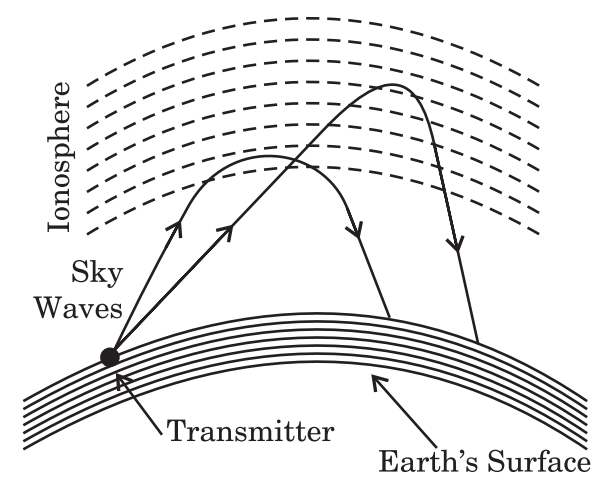
(i) Which mode of propagation is used by short wave broadcast services having frequency range from a few MHz to 30 MHz? Explain diagrammatically how long distance communication can be achieved by this mode.
(ii) Why is there an upper limit to frequency of waves used in this mode ?
Answer

(i) Sky wave propagation is used by short wave broadcast services having frequency range from few MHz to 30 MHz.
Long Distance Communication by Sky Wave Propagation : The radio waves which travel from the transmitting to the receiving antenna after being reflected from the ionosphere are called 'sky waves' and the phenomenon is known as 'sky-wave propagation'. In this mode of transmission radio waves can travel through very large distances and can even travel around the earth.
Mechanism of reflection of Sky Waves from the ionosphere : The reflection of e.m. waves from the ionosphere is caused by the oscillating electric field of e.m. waves (say of frequency $\omega$) that changes the velocity of electrons in the ionosphere. It changes the effective dielectric constant $\in^{\prime}$ and also the refractive index $n^{\prime}$ as compared to free space with value of the above quantities as $\omega_0$ and $n_{0}$, respectively. These quantities are related as follows :
$n^{\prime}=\sqrt{\varepsilon^{\prime} \mu_0}$
$=\sqrt{\varepsilon_0 \mu_0\left[1-\left( N e^2 \varepsilon_0 m \omega^2\right)\right]}$
or $n^{\prime}=n_0\left[1-\left(N e^2 / \varepsilon_0 m \omega^2\right)\right]^{1 / 2}$ ...(1)
Image
where $e$ is the electronic charge, $m$ is the mass of electron and $n$ is the density of electrons in ionosphere. The ionosphere behaves as a rarer medium because its refractive index is less than its free space value of no. Therefore, the wave turns away from the normal when it enters the ionosphere. As we go deep into the ionosphere (the density of electrons, N is large), the refractive index keeps on decreasing. The bending of the beam will continue till it reaches the critical angle after which it is reflected back. It is seen from equation (1) that different frequencies (ω) will be reflected from different regions of the ionosphere having different values of N. Therefore, different points on earth receive signals reflected from different depths of the ionosphere. In case, the frequency is too high, then after a certain value the electron density N may never be so high as to produce enough bending for attaining critical angle. This is called critical frequency. If the maximum electron density of the ionosphere is Nmax per m³, then the critical frequency $f_c$ is approximately calculated by :
$f_c=9\left(N_{\max }\right)^{1 / 2}$
The $f_c$ ranges approximately from 5 to 10 MHz . If the frequencies are higher than this range, they cross the ionosphere and do not come back to the earth.
(ii) There is an upper limit because for frequencies above 30 MHz radiowaves penetrate through ionosphere and escape i.e. never come back to earth.

Need a full question paper?

Generate a complete, print-ready paper with questions like this in minutes — across 16+ boards, with answer keys.

Start Generating Free

Similar questions

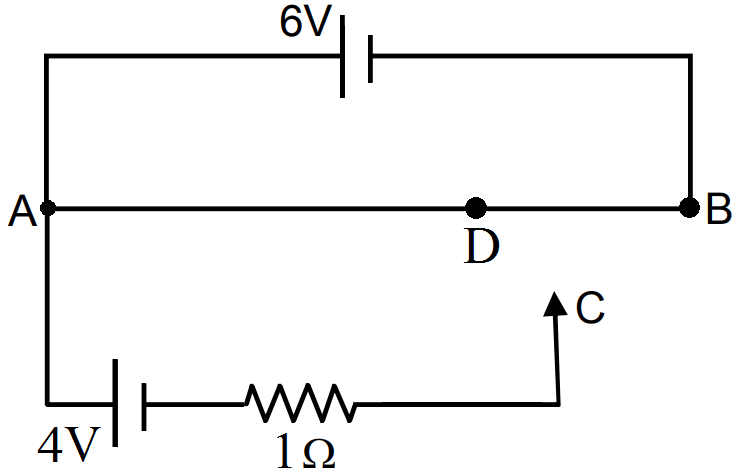
A $6$ volt battery of negligible internal resistance is connected across a uniform wire $AB$ of length $100\ cm.$ The positive terminal of another battery of emf $4V$ and internal resistance $1\Omega$ is joined to the point $A,$ as shown in the figure. Take the potential at $B$ to be zero.$ (a)$ What are the potentials at the points $A$ and $C$ ? $(b) $ At which point $D$ of the wire $AB,$ the potential is equal to the potential at $C$ ? $ (c)$ If the points $C$ and $D$ are connected by a wire, what will be the current through it? $(d)$ If the $4V$ battery is replaced by a $7.5V $ battery, what would be the answers of parts $(a)$ and $(b)$?
A wave travels along the positive x-direction with a speed of 20m/s. The amplitude of the wave is 0.20cm and the wavelength 2.0cm.
  1. Write a suitable wave equation which describes this wave.
  2. What is the displacement and velocity of the particle at x = 2.0cm at time t = 0 according to the wave equation written? Can you get different values of this quantity if the wave equation is written in a different fashion?
A glass surface is coated by an oil film of uniform thickness $1.00 \times 10^{-4}cm.$ The index of refraction of the oil is $1.25$ and that of the glass is $1.50.$ Find the wavelengths of light in the visible region $(400\ nm - 750\ nm)$ which are completely transmitted by the oil film under normal incidence.
Two point charges $q_A=3 \mu C$and $q _{ B }=$$-3 \mu C$ are located 20 cm apart in vacuum.
(a) What is the electric field at the midpoint O of the line AB joining the two charges?
(b) If a negative test charge of magnitude $1.5 \times$$10^{-9} C$ is placed at this point, what is the force experi-enced by the test charge?
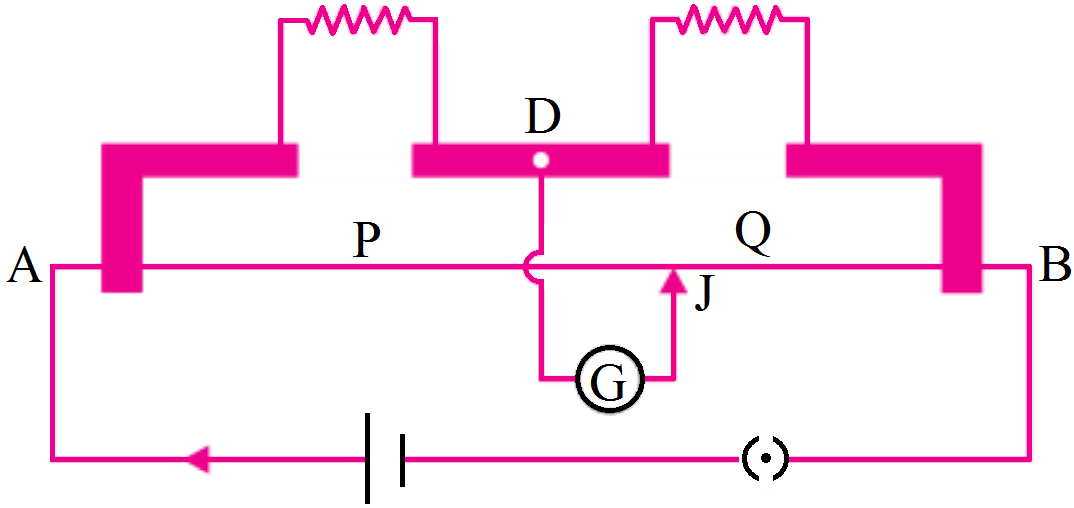
In a practical Wheatstone bridge circuit, wire $AB$ is $2\ m$ long. When resistance $Y = 2.0W$ and jockey is in position $J$ such that $AJ = 1.20\ m$, there is no current in galvanometer, find the value of unknown resistance $X$. The resistance per unit length of wire $AB = 0.01W/ cm$. Also calculate the current drawn by the cell of emf $4.0V$ and negligible internal resistance.
A glass window is to be fit in an aluminium frame. The temperature on the working day is $40^\circ C$ and the glass window measures exactly $20\ cm \times 30\ cm$. What should be the size of the aluminium frame so that there is no stress on the glass in winter even if the temperature drops to $0^\circ C$ ? Coefficients of linear expansion for glass and aluminium are $9.0 \times 10^{-6 ^\circ} C^{-1}$ and $24 \times 10^{-6^\circ} C^{-1}$ respectively.
A gas is enclosed in a cylindrical can fitted with a piston. The walls of the can and the piston are adiabatic. The initial pressure, volume and temperature of the gas are $100kPa, 400\ cm^3$ and $300K,$ respectively. The ratio of the specific heat capacities of the gas is $\frac{\text{C}_\text{P}}{\text{C}_\text{V}}=1.5.$ Find the pressure and the temperature of the gas if it is,
  1. Suddenly compressed.
  2. Slowly compressed to $100\ cm^3.$

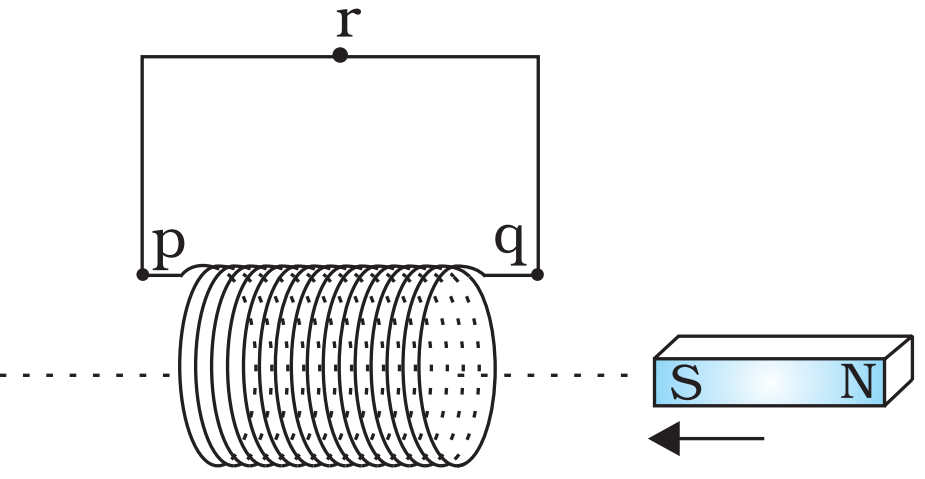
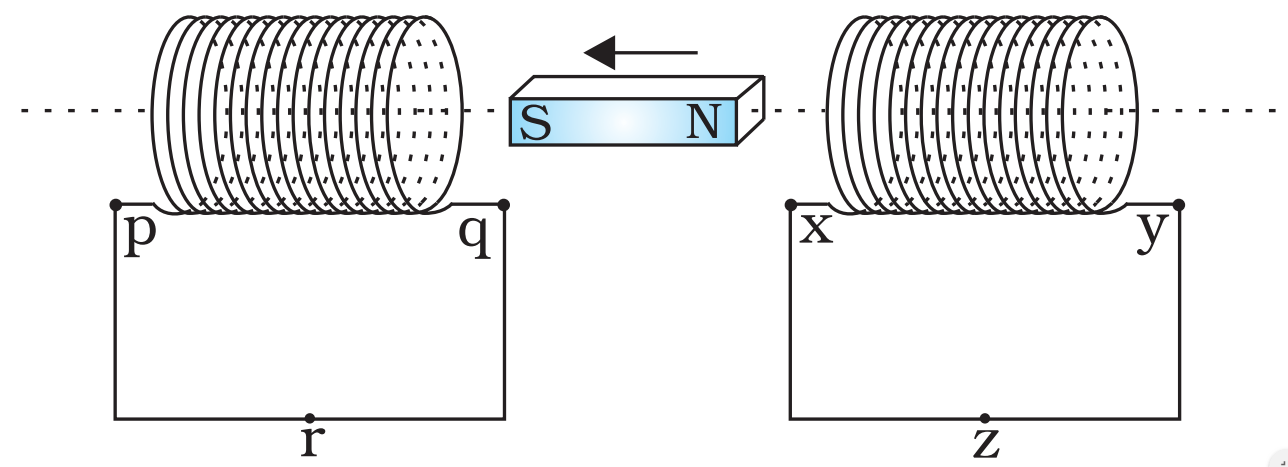
Predict the direction of induced current in the situations described by the following Figs. (a) to (f).
  1.  
  1.  
  1.  
  1.  
  1.  
  1.  
A particle executes a simple harmonic motion of amplitude $1.0\ cm$ along the principal axis of a convex lens of focal length $12\ cm.$ The mean position of oscillation is at $20\ cm$ from the lens. Find the amplitude of oscillation of the image of the particle.
Two spherical bodies, each of mass 50kg, are placed at a separation of 20cm. Equal charges are placed on the bodies and it is found that the force of Coulomb repulsion equals the gravitational attraction in magnitude. Find the magnitude of the charge placed on either body.