Question
$i$. Write the electron $-$ dot structures for sodium, oxygen and magnesium.
$ii$. Show the formation of $\ce{Na _2 O}$ and $\ce{MgO}$ by the transfer of electrons.
$iii$. What are the ions present in these compounds?
Answer

$i$.
Metal Symbol Atomic number Electronic configuration $K, L, M, N$ No. of outermost electrons Electron dot structures
Sodium $Na$ $11$ $2, 8, 1$ $1$ $Na.$
Oxygen $O$ $8$ $2, 6$ $6$ $:O::$
Magnesium $Mg$ $12$ $2, 8, 6$ $2$ $Mg:$
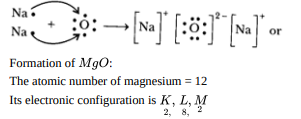
$ii.$ Formation of $\ce{Na _2 O}$
The atomic number of sodium is $11$ and it has only one valence electron.
Hence, electronic configuration of ${ }_{11} N a$ is $2, 8, 1.$
The atomic number of oxygen is $8$ and it has $6$ electrons in its valence shell.
Hence, electronic configuration of ${ }_8 O$ is $2, 6$.
Sodium has a tendency to lose the valence electron and oxygen has a tendency to gain the electron lost by sodium. Since,
sodium can lose only one electron of the valence shell, and oxygen atom needs two electrons to complete its octet in the
valence electron, two atoms of sodium combine with one atom of oxygen.
By losing valence electron, sodium is changed into
$N a^{+}$ and by gaining two electrons lost by two sodium atoms, oxygen atom is changed into an oxide anion, $O _2$. In this process, both the atoms, sodium and oxygen, obtain the stable electronic configuration of the noble gas neon.
$\underset{2,8,1}{ Na } \rightarrow \underset{2,8}{ Na ^{+}}+e^{-} O ^{2-}$
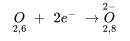
$O _{2,6}+2 e^{-} \rightarrow O _{2,8}^{2-}$
$2 Na ^{+}+ O ^2 \xrightarrow{\rightarrow} 2 Na ^{+} O ^{2-} \text { or } \ce{Na a_2 O} $
The oppositely charged sodium ion $Na ^{+} O ^{2-}$ , and oxide ion $O^{2-}$ , are now held together by electrostatic force of attraction or by ionic or electrovalent bond. $\ce{Na _2 O}$ is, therefore, an ionic or electrovalent compound.

Image
It has two electronic in its outermost shell.
So, the magnesium atom donates its $2$ valence electrons and forms a stable
magnesium ion $Mg ^{2+}$ , to attain the electronic arrangement of neon atom.
$\underset{2,8,2}{\operatorname{Mg}} \rightarrow \underset{2,8}{\stackrel{2+}{M g}}+2^{e-}$
The atomic number of oxygen $= 8$
Electronic configuration $ = \underset{2}{K}, \underset{6}{L}$
It has $6$ electrons in its valence shell.
Therefore, it requires $2$ more electrons to attain the stable electronic arrangement of neon gas.
Thus, oxygen accepts $2$ electrons donated by magnesium atom and forms a stable oxide ion $O^{2-}$.
Image

The oppositely charged magnesium ions $Mg ^{2+}$ , and oxide ions, are held together by a strong force of electrostatic attraction to form magnesium oxide compound.
$\ce{MgO}$ is ionic compound.
$iii$. The ions present in $\ce{Na _2 O}$ are sodium ions $\left(\ce{2 N a}^{+}\right)$ and oxide ion $O ^{2-}$.
The ions present in $\ce{M g O} $ are magnesium ion $\ce{(Mg2+)}$ and oxide ion $O ^{2-}$.

Need a full question paper?

Generate a complete, print-ready paper with questions like this in minutes — across 16+ boards, with answer keys.

Start Generating Free

Similar questions

Derive the expression for the heat produced due to a current ‘I’ flowing for a time interval ‘t’ through a resistor ‘R’ having a potential difference ‘V’ across its ends. With which name is this relation known?
a. Draw a diagram of human alimentary canal and label - gall bladder, pancreas, liver and small intestine on it.
b. Give two reasons to explain why absorption of digested food occurs mainly in the small intestine.
Why could no fixed position be given to hydrogen in Mendeleev’s periodic table?
A lens forms a real image 3cm high of an object 1cm high. If the separation of object and image is 15cm, find the focal length of the lens.
What is ten per cent law? Explain with an example.
Consider the following elements:
Ca, Cl, Na, I, Li, Ba, Sr, K, Br.
Separate these elements into three groups (families) of similar properties. State one property in each case on the basis of which you have made your choice.
Where do plants get each of the raw materials required for photosynthesis?
Describe with the help of a ray-diagram, the formation of image of a finite object placed in front of a convex lens between f and 2f Give two characteristics of the image so formed.
Explain the phenomenon of “biological magnification.” How does it affect organisms belonging to different trophic levels particularly the tertiary consumers?
Explain analogous organs and homologous organs. Identify the analogous and homologous organs amongst the following:
Wings of an insect, wings of a bat, forelimbs of frog, forelimbs of a human.