Question
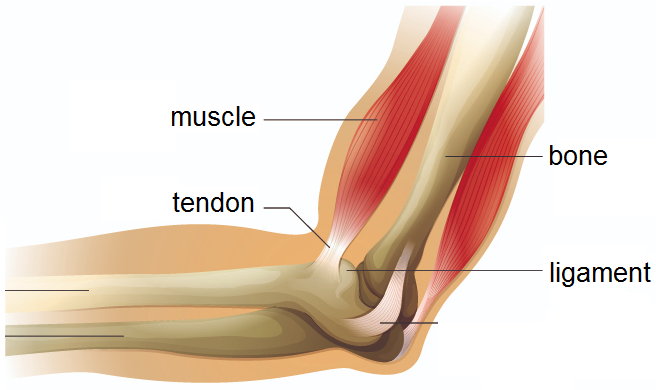
  1. Identify $A, B, C$ and $D.$
  2. Write the functions of $A, B, C$ and $D.$
  3. Write the difference between $A$ and $D.$
Answer

  1. $A-$ Tendon
$B-$ Bone
$C-$ Muscle
$D-$ Ligament
  1. $A-$ The main function of a tendon is to connect skeletal muscles to bones. Tendons are a type of connective tissue, and the primary building blocks of tendons are collagen fibers.
$B-$ Bones have many functions. They support the body structurally, protect our vital organs, and allow us to move. Also, they provide an environment for bonemarrow, where the blood cells are created, and they act as a storage area for minerals, particularly calcium.
$C-$ the main function of the muscular system is movement, but it also helps stabilize our joints, maintain our posture and generate heat during activity. Movement of our body can be voluntary and controlled by the skeletal muscles, or it can be involuntary and controlled by smooth muscles.
$D-$ Ligaments attach two bones or cartilages,it helps in supporting and keeping the organ in position, it is made of fibrous tissue.
  1.  
Tendons
Ligaments
Connects skeletal muscles to bones
Connects bones to bones
Tough and elastic
Elastic
Connects the end of the muscles to bones
Connects the end of the bones at joints
Each muscle contains only one tendon
Each joint contains many ligaments
Proteoglycan content is less
Proteoglycan content is more
White in colour
Yellow in colour
Blood supply is good
Blood supply is poor
Fibroblasts lie in a continuous row
Fibroblasts are scattered
The fibres and compact and present in parallel bundles
They are not arranged in parallel bundles but are compactly packed
No such classification
They are classified into $3$ types, namely: Articular ligaments, Remnant ligaments and Peritoneal Ligaments

Need a full question paper?

Generate a complete, print-ready paper with questions like this in minutes — across 16+ boards, with answer keys.
Start Generating Free

Similar questions

Name two indigenous and two exotic breeds of poultry. Write a note on egg production and broiler production.
Name major phyla of Animal kingdom. Write down one character and one example of each of them.
Describe the mechanism of osmosis. Give its importance.
What are cell organelles? Write the names of different cell organelles.
You are given leech, Nereis, Scolopendra, prawn and scorpion, and all have segmented body organisation. Will you classify them in one group? If no, give the important characters based on which you will separate these organisms into different groups.
How is green revolution different from white revolution?
There is a large group of materials $P$ which can be divided into three groups $Q, R,$ and $S$ on the basis of their properties. The substances belonging to group $Q$ can be solids, liquids or gases. The solids belonging to group $Q$ are usually electrical insulators. Most of the substances of group $R$ are solids which are good conductors of electricity. The substances belonging to group S are neither insulators like $Q$ nor good conductors like $R$. The properties of S are intermediate between those of $Q$ and $R$.
  1. What could the group of materials $P$ be?
  2. Name the substances $Q$. Give two examples of such substances.
  3. Name the substances $R$. Write two examples of such substances.
  4. Name the substances $S$. Give two examples of such substances.
  5. Out of $Q, R$ and $S$, which substances are malleable and ductile?
An element is sonorous and highly ductile. Under which category would you classify this element? What other characteristics do you expect the element to possess?
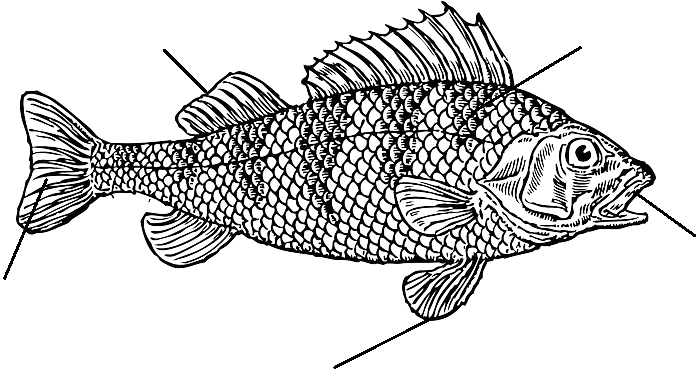
  1. Identify the figure and write down its class.
  2. Label A, B, C, and D.
  3. What if its respiratory organs?
  4. What type of adaptation this creature has?
  5. What type of endoskeleton it has?
Explain the structure of neuron with the help of a labelled diagram