Question
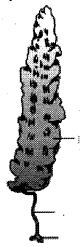
Identify below figure.
Generate a complete, print-ready paper with questions like this in minutes — across 16+ boards, with answer keys.
$\begin{array}{|p{0.3\linewidth}|l|} \hline Column\,\,-I & Column\,\,-II \\ \hline (1)\,\,Typical\,\,bacterial & (p)\,\,Site\,\,of\,\,protein\,\,synthesis \\ \hline (2)\,\,Ribosome & (q)\,\,1-2\,\,\mu\,m \\ \hline (3)\,\,Long\,\,and\,\,branched & (r)\,\,Control\,\,of\,\,bacterial\,\,transform \\ \hline (4)\,\,Plasmid & (s)\,\,Nerve\,\,cell \\ \hline \end{array}$
Statement $I:$ Gause's 'Competitive Exclusion Principle' states that two closely related species competing for the same resources cannot co-exist indefinitely and competitively inferior one will be eliminated eventually.
Statement $II:$ In general, carnivores are more adversely affected by competition than herbivores.
In the light of the above statements, choose the correct answer from the options given below: