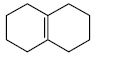
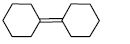
MCQ
Identify $'E'$ (major) product ?
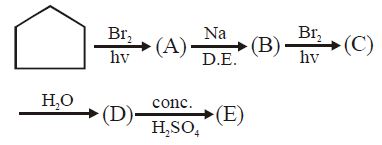
  • B

  • C

  • D

Answer

Correct option: A.

a

Need a full question paper?

Generate a complete, print-ready paper with questions like this in minutes — across 16+ boards, with answer keys.

Start Generating Free

Similar questions

$\xrightarrow[{hv}]{{NBS}}$ Product ;

Which product will not likely to form

The order of energy absorbed which is responsible for the color of complexes

$(A)$ $\left[ Ni \left( H _{2} O \right)_{2}( en )_{2}\right]^{2+}$

$(B)$ $\left[ Ni \left( H _{2} O \right)_{4}(\text { en })\right]^{2+}$ and

$(C)$ $\left[ Ni ( en )_{3}\right]^{2+}$ is ...... .

The compound in which carbon uses only its $s{p^3}$ hybrid orbitals for bond formation is
The rate coefficient $(k)$ for a particular reactions is $1.3 \times 10^{-4}\,M^{-1}\, s^{-1}$ at $100\,^oC,$ and $1.3 \times 10^{-3}\,M^{-1}\,s^{-1}$ at $150\,^oC$. What is the energy of activation $(E_A)$ (in $kJ$ ) for this reaction? ( $R =$ molar gas constant $= 8.314\,JK^{-1}\,mol^{-1}$ )
Match List $-I$ with List $-II$ and select the correct answer using the codes given below

List $-I$

(Ion involved)

List $-II$

(agent)

$(i)\, Ni^{2+}$ $(A)$ Sodium thiosulphate
$(ii)\, Ag^+$ $(B)$ Sodium nitroprusside
$(iii)\, Cu^{2+}$ $(C)$ Ammonia
$(iv)\,S^{2-}$ $(D)$ Dimethylglyoxime

$(i)\,\,\,-\,\,\,(ii)\,\,\,-\,\,\,(iii)\,\,\,-\,\,\,(iv)$

The pentavalence in phosphorus is more stable as compared to that of nitrogen even though they belong to the same group. It is due to
(image) $\xrightarrow[{(2)\,{H_2}O/Zn}]{{(1)\,{O_3}}}\mathop X\limits_{\left( {{C_2}{H_4}O} \right)}  + \mathop Y\limits_{\left( {{C_3}{H_6}O} \right)} $ 

$X\xrightarrow[{\left( 2 \right)\,{H_2}O}]{{\left( 1 \right)\,LiAl{H_4}}}P$

$Y\xrightarrow[{\left( 2 \right)\,{H_2}O}]{{\left( 1 \right)\,LiAl{H_4}}}Q$

Incorrect statement for $X, Y, P$ and $Q$ is

A solution of two miscible liquids showing negative deviation from Raoult's law will have :
Which compound on electrolysis produces $H_2$ gas at both electrode?
Which metal is protected by a layer of its own oxide