Question
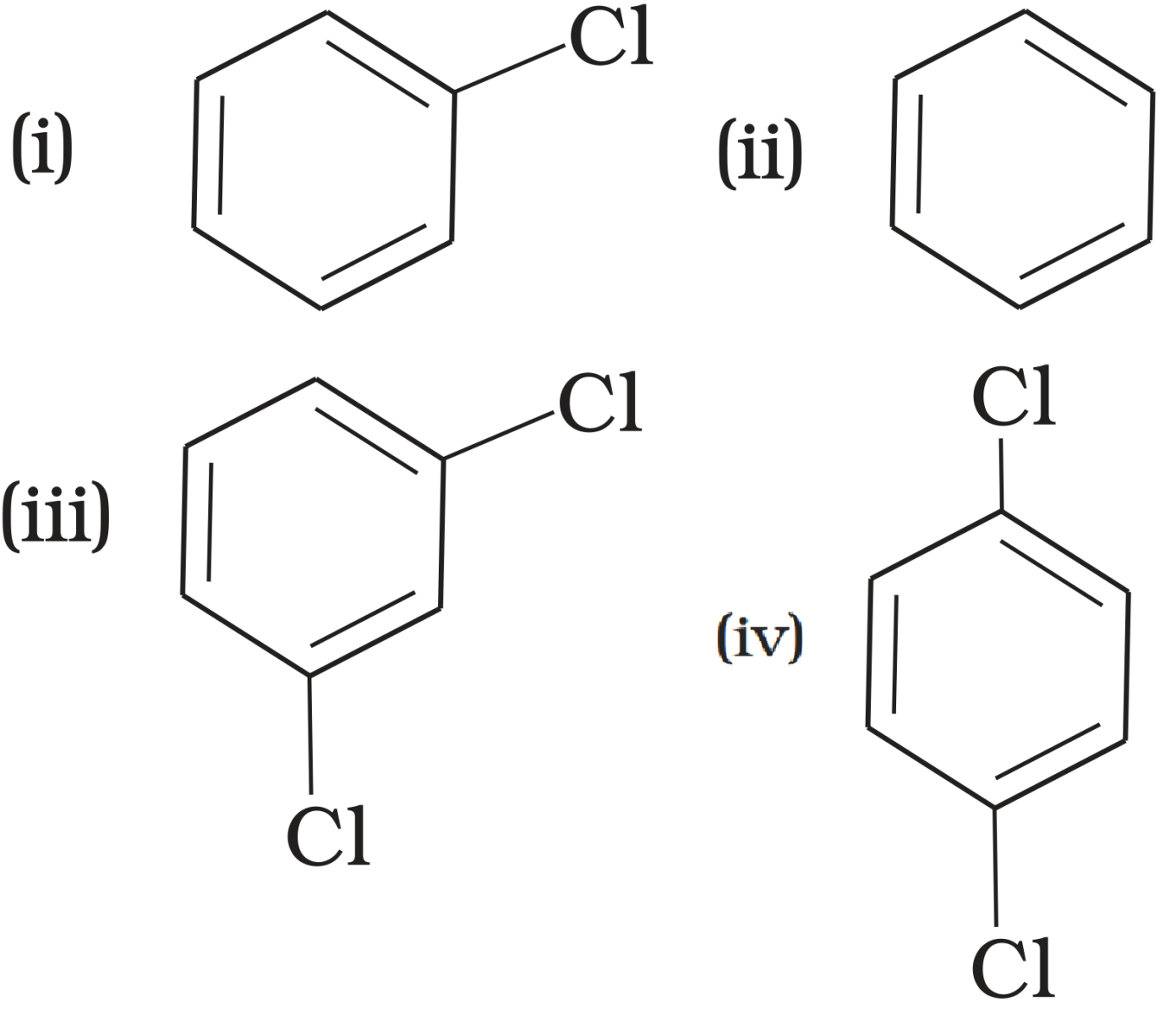
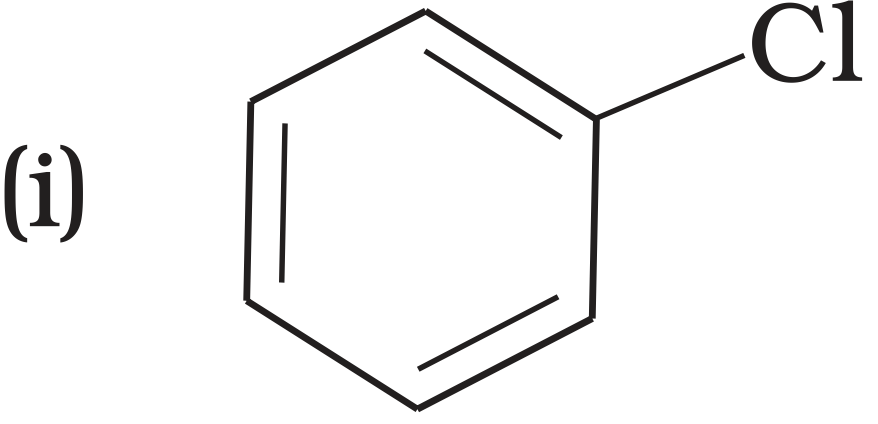
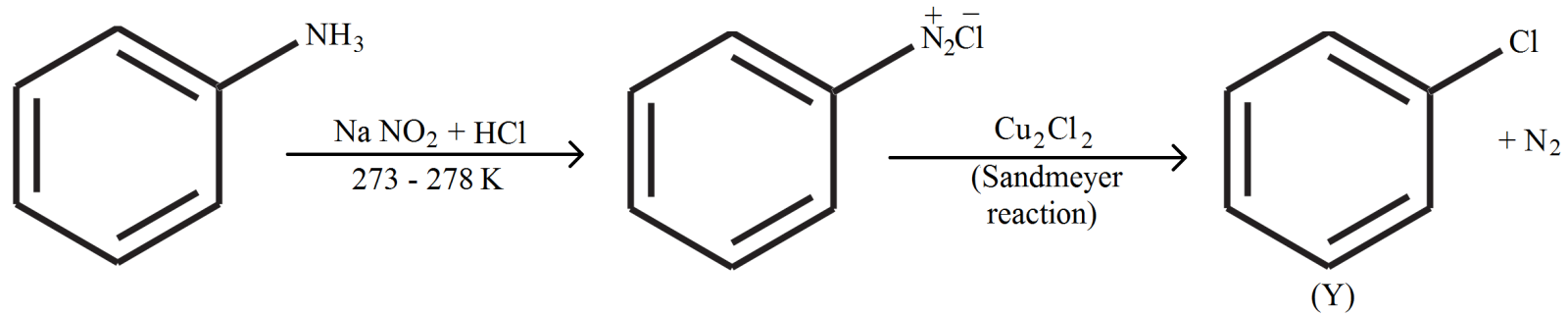
Identify the compound Y in the following reaction.

Explanation:
When a primary aromatic amine, dissolved or suspended in cold aqueous mineral acid and treated with sodium nitrite, a diazonium salt is formed. When this freshly prepared diazonium salt is mixed with cuprous chloride, diazonium group is replaced by -Cl.
Then chlorobenzene is formed which is Y in this reaction.
Generate a complete, print-ready paper with questions like this in minutes — across 16+ boards, with answer keys.
(Given : $K_b$ of water $=0.5\ Kkg/mol$ . ; Atomic mass of $Ca =40$ , $Br =80$)
$(i) \,\,\begin{array}{*{20}{c}}
{C{H_3}\,\,\,\,\,\,\,\,\,\,\,} \\
{|\,\,\,\,\,\,\,\,\,\,\,\,\,\,\,\,\,\,} \\
{C{H_3} - C - CH - C{H_3}} \\
{\,\,\,\,\,|} \\
{\,\,\,\,\,\,\,\,\,\,\,\,OH}
\end{array}\,\xrightarrow{{{H^ + }/heat}}\,\,\mathop A\limits_{[Major\,product]} \, + \,\mathop B\limits_{[Minor\,product]} $
$(ii)\,\, A\xrightarrow[{in\,\,absence\,\,\,of\,peroxide}]{{HBr,\,dark}}\,\,\mathop C\limits_{[Major\,product]} \, + \,\mathop D\limits_{[Minor\,product]} $
the major products $(A)$ and $(C)$ are respectively