MCQ
Identify the correct definition
  • A
    If after every certain interval of time, particle repeats its motion then motion is called periodic motion
  • B
    To and fro motion of a particle over the same path about its mean position in certain time interval is called oscillatory motion
  • C
    Oscillatory motion described in terms of single sine and cosine functions is called simple harmonic motion
  • All of these

Answer

Correct option: D.
All of these
d
(d)

All the above definition are true.

Hence answer is $(d)$

Need a full question paper?

Generate a complete, print-ready paper with questions like this in minutes — across 16+ boards, with answer keys.

Start Generating Free

Similar questions

In a thermodynamic process, pressure of a fixed mass of a gas is changed in such a manner that the gas molecules gives out $20 J$ of heat and $10 J$ of work is done on the gas. If the initial internal energy of the gas was $40 J,$ then the final internal energy will be ........ $J$
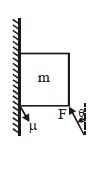
A block of mass $m$ (initially at rest) is sliding up (in vertical direction) against a rough vertical wall with the help of a force $F$ whose magnitude is constant but direction is changing. $\theta  = {\theta _0}t$  where $t$ is time in sec. At $t$ = $0$ , the force is in vertical upward direction and then as time passes its direction is getting along normal, i.e., $\theta  = \frac{\pi }{2}$ .The value of $F$ so that the block comes to rest when $\theta  = \frac{\pi }{2}$ , is 
A $1.0\, kg$ ball drops vertically into a floor from a height of $25\, cm$. If rebounds to a height of $4\ cm$. The coefficient of restitution for the collision is
What will be the wave velocity, if the radar gives $54$ waves per min and wavelength of the given wave is $10\, m$  ......  $m/sec$
Three perfect gases at absolute temperatures $T_1 , T_2$ and $T_3$ are mixed. The masses of molecules are $m_1 , m_2$ and $m_3$ and the number of molecules are $n_1, n_2$ and $n_3$ respectively. Assuming no loss of energy, the final temperature of the mixture is
Which two of the given transverse waves will give stationary waves when get superimposed

${z_1} = a\cos (kx - \omega \,t)$.....$(A)$

${z_2} = a\cos (kx + \omega \,t)$.....$(B)$

${z_3} = a\cos (ky - \omega \,t)$..... $(C)$

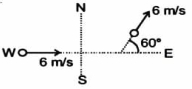
A particle is moving eastwards with a speed of $6 \,m / s$. After $6 \,s$, the particle is found to be moving with same speed in a direction $60^{\circ}$ north of east. The magnitude of average acceleration in this interval of time is ....... $m / s ^2$
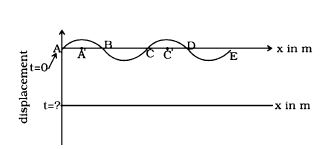
The pattern of standing waves formed on a stretched string at two instants of time (extreme,mean) are shown in figure. The velocity of two waves superimposing to form stationary waves is $360\  ms^{-1}$ and their frequencies are $256\  Hz$. Which is not possible value of $t$ (in $sec$)
Which of the sets given below may represent the magnitudes of three vectors adding to zero?
Keeping the number of moles, volume and temperature the same, which of the following are the same for all ideal gases?