MCQ
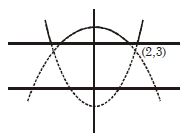
Identify the correct statement about function $f(x) = max(x^2 -1, 7 -x^2, 5)$
  • $f(x)$ is not differentiable at $4$ points
  • B
     range of $f(x)$ is $\left[ {3,\infty } \right)$
  • C
    $f(x)$ is an injective function
  • D
    $f(x)$ is discontinuous at $4$ points.

Answer

Correct option: A.
$f(x)$ is not differentiable at $4$ points
a

Need a full question paper?

Generate a complete, print-ready paper with questions like this in minutes — across 16+ boards, with answer keys.

Start Generating Free

Similar questions

Let $A=\{1,2,3,5,8,9\}$. Then the number of possible functions $f : A \rightarrow A$ such that $f(m \cdot n)=f(m) \cdot f(n)$ for every $m, n \in A$ with $m \cdot n \in A$ is equal to $...............$.
The solution set of the inequation 3x + 2y > 3 is:
  1. Half plane not containing the origin
  2. Half plane containing the origin
  3. The point being on the line 3x + 2y = 3
  4. None of these
The differential equation of the family of curves represented by the equation ${x^2}y = a$, is
If $\left|\begin{array}{ccc}5 & 3 & -1 \\ -7 & x & -3 \\ 9 & 6 & -2\end{array}\right|=0$, then the value of $x$ is
If $u = {\tan ^{ - 1}}{y \over x}$, then by Euler’s Theorem the value of $x$ ${{\partial u} \over {\partial x}} + y{{\partial u} \over {\partial y}} = $
Let the solution curve $x=x(y), 0 < y < \frac{\pi}{2}$, of the differential equation $\left(\log _e(\cos y)\right)^2 \cos y dx -(1+3 x$ $\left.\log _e(\cos y)\right) \sin y dy =0$ satisfy $x\left(\frac{\pi}{3}\right)=\frac{1}{2 \log _e 2}$. If $x\left(\frac{\pi}{6}\right)=\frac{1}{\log _e m-\log _e n}$, where $m$ and $n$ are co-prime, then $mn$ is equal to $.....$.
If the matrix is a square matrix and it contains 36 elements, then the order of the matrix is:
  1. 4 × 4
  2. 8 × 8
  3. 6 × 6
  4. 3 × 3
If $f(x) = \frac{{{e^x}}}{{1 + {e^x}}},\,\,\,\;{I_1} = \int_{f( - a)}^{f(a)} {xg\{ x(1 - x)\} dx} $, and ${I_2} = \int_{f( - a)}^{f(a)} {g\{ x(1 - x))\} dx} $, then the value of $\frac{{{I_2}}}{{{I_1}}}$ is
If $u = {\log _e}({x^2} + {y^2}) + {\tan ^{ - 1}}\left( {{y \over x}} \right)$, then ${{{\partial ^2}u} \over {\partial {x^2}}} + {{{\partial ^2}u} \over {\partial {y^2}}} = $
If $A=\left[\begin{array}{r}1 \\ -4 \\ 3\end{array}\right]$ and $B=\left[\begin{array}{lll}-1 & 2 & 1\end{array}\right]$, then $(A B)^{\prime}$ is equal to