MCQ
Identify the correct statement regarding a spontaneous process :
  • A
    Lowering of energy in the process is the only criterion for spontaneity.
  • For a spontaneous process in an isolated system, the change in entropy is positive.
  • C
    Endothermic processes are never spontaneous.
  • D
    Exothermic processes are always spontaneous.
Answer

Correct option: B.
For a spontaneous process in an isolated system, the change in entropy is positive.
b
Spontaneity of reaction depends on tendency to acquire minimum energy state and maximum randomness. For a spontaneous process in an isolated system the change in entropy is positive.

Need a full question paper?

Generate a complete, print-ready paper with questions like this in minutes — across 16+ boards, with answer keys.

Start Generating Free

Similar questions

$1$ mole of a diatomic is heated through isochoric process from $300\,K$ to $500 \,K$. The entropy is :
The type of hybridisation of boron in diborane is
Calculate the enthalpy change on freezing of 1.0 mol of water at $10.0^{\circ} C$ to the ice at $-10.0^{\circ} C . \Delta_{\text {fus }} H =6.03 kJ$ $\operatorname{mol}^{-1}$ at $0^{\circ} C$.
a. $C _{ P }\left[ H _2 O ( l )\right]=75.3 Jmol ^{-1} K^{-1}$
b. $C _{ P }\left[ H _2 O ( s )\right]=36.8 Jmol ^{-1} K^{-1}$
At 363K, pure water has [H2O+] = 10-6M. The value of Kw at this temperature will be:
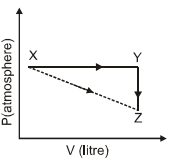
For an ideal gas, consider only $P - V$ work in going from an initial state $X$ to the final stat $Z$. The final state $Z$ can be reached by either of the two paths shown in the figure. Which of the following choice$(s)$ is (are) correct? [take $\Delta S$ as change in entropy and w as work done].

$(A)$ $\Delta S _{ x \rightarrow z}=\Delta S _{ x \rightarrow y}+\Delta S _{ y \rightarrow z}$

$(B)$ $w_{x \rightarrow z}=w_{x \rightarrow y}+w_{y \rightarrow z}$

$(C)$ $w_{x \rightarrow z \rightarrow z}=w_{x \rightarrow y}$

$(D)$ $\Delta S _{x \rightarrow y \rightarrow z}=\Delta S _{x \rightarrow y}$

Ionic bonds will be formed more easily between elements with comparatively:
The $pH$  of millimolar $HCl$  is
Propene is allowed to react with B2​ D6​ and the product is treated with acetic acid. The final product obtained is:
The solubility of silver chromate in $0.01 \,M$ ${K_2}Cr{O_4}$ is $2 \times {10^{ - 8}}\,mol\,d{m^{ - 3}}$. The solubility product of silver chromate will be