Question
Identify the following electromagnetic radiations as per the frequencies given below:
  1. 1020Hz
  2. 109Hz
  3. 1011Hz
Write one application of each.

Answer

  1. 1020Hz → γ-radiation,

Application: For treatment of cancer.

  1. 109Hz → Radio waves,

Application: For broadcasting radio-programmes to long distances.

  1. 1011Hz → Microwaves,

Application: For cooking in microwave oven.

Need a full question paper?

Generate a complete, print-ready paper with questions like this in minutes — across 16+ boards, with answer keys.
Start Generating Free

Similar questions

A current-carrying circular coil of 100 turns and radius 5.0cm produces a magnetic field of 6.0 × 10⁻⁵T at its centre. Find the value of the current.
In Young’s double slit experiment, monochromatic light of wavelength 630 nm illuminates the pair of slits and produces an interference pattern in which two consecutive bright fringes are separated by 8.1 mm. Another source of monochromatic light produces the interference pattern in which the two consecutive bright fringes are separated by 7.2 mm. Find the wavelength of light from the second source.
What is the effect on the interference fringes if the monochromatic source is replaced by a source of white light?
  1. Identify the part of the electromagnetic spectrum which is:
  1. Suitable for radar system used in aircraft navigation,
  2. Produced by bombarding a metal target by high-speed electrons.
  1. Why does a galvanometer show a momentary deflection at the time of charging or discharging a capacitor? Write the necessary expression to explain this observation.
A charged particle having a charge of -2.0 × 10⁻⁶C is placed close to a nonconducting plate having a surface charge density 4.0 × 10⁻⁵Cm-2. Find the force of attraction between the particle and the plate.
An electron and a positron moving at small speeds collide and annihilate each other. Find the energy of the resulting gamma photon.
To increase the current sensitivity of a moving coil galvanometer by 50%, its resistance is increased so that the new resistance becomes twice its initial resistance. By what factor does its voltage sensitivity change?
n-identical cells, each of emf $\varepsilon,$ internal resistance r connected in series are charged by a dc source of emf $\varepsilon'$ using a resistance R.
  1. Draw the circuit arrangement.
  2. Deduce expressions for (a) the charging current and (b) the potential difference across the combination of cells.
Two circular loops are placed coaxially but separated by a distance. A battery is suddenly connected to one of the loops establishing a current in it. Will there be a current induced in the other loop? If yes, when does the current start and when does it end? Do the loops attract each other or do they repel?
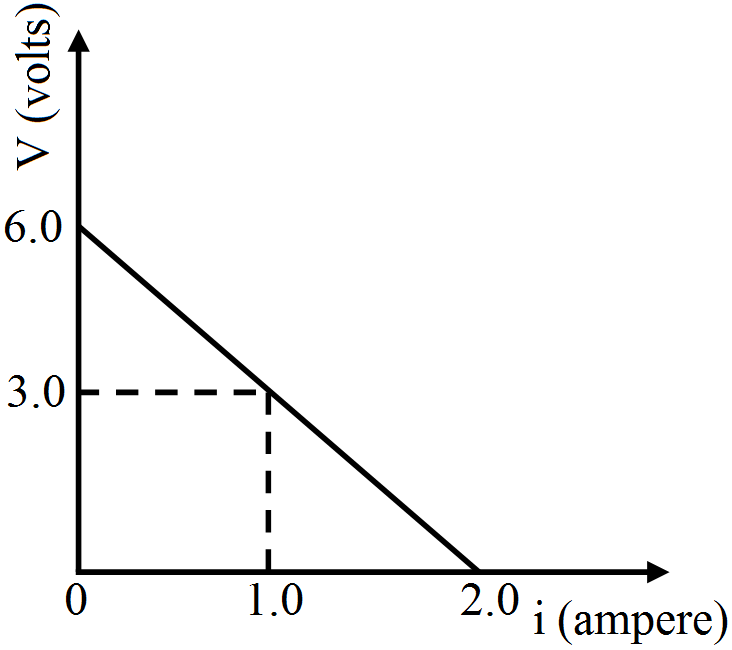
The graph shown here shows the variation of terminal potential difference V, across a combination of three cells in series to a resistor, versus current i:

  1. Calculate the emf of each cell.
  2. For what current i, will the power dissipation of the circuit be maximum?