Question
Identify the plant bodies, which are commonly named as “cryptogamae”. State and explain two characteristics which are exhibited by each category of these plant bodies.

Answer

Plant bodies which are commonly named as “cryptogamae” are:
  1. Thallophyta.
  2. Bryophyta.
  3. Pteridophyta.
Characteristics of these plant bodies are:
  1. Thallophyta:
  • Plants have an irregular shaped undifferentiated body called thallus.
  • Vascular tissues are absent.
  1. Bryophyta:
  • The plant body is commonly differentiated to form stem and leaf-like structures.
  • There is no specialised tissue for the conduction of water and other substances from one part of the plant body to another.
  1. Pteridophyta:
  • The plant body is differentiated into roots, stem and leaves.
  • These plants have specialised tissue for the conduction of water and other substances from one part of the plant body to another.

Need a full question paper?

Generate a complete, print-ready paper with questions like this in minutes — across 16+ boards, with answer keys.

Start Generating Free

Similar questions

An atom of an element $X$ may be written as $^{9}_4\text{X} $
  1. What does the figure $9$ indicate$?$
  2. What does the figure $4$ indicate$?$
  3. What is the number of protons in atom $X?$
  4. What is the number of neutrons in atom $X?$
  5. What is the number of electrons in atom $X?$
  6. How many electrons are there in the outermost shell of an atom of element $X?$
  7. Write the symbol of ion formed by an element $Z$ is $2, 8, 8$.
The following data was obtained for a body of mass $1kg$ dropped from a height of $5$ metres:
 
Distance above ground
Velocity
$i.$
$5m$
$0m/s$
$ii.$
$3.2m$
$6m/s$
$iii.$
$0m$
$10m/s$
Show by calculations that the above data verifies the law of conservation of energy (Neglect air resistance). $(g = 10m/s^2).$
State the main points of difference between homogeneous and heterogeneous mixtures.
Describe an experiment to show that sound cannot pass through vacuum.
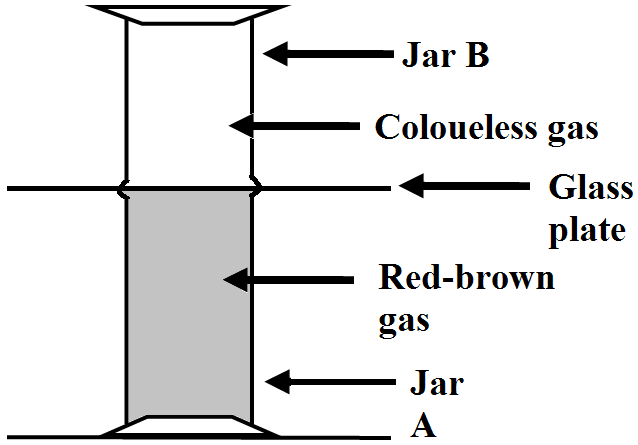
Look at the diagram on the right side. Jar $A$ contains are d-brown gas whereas Jar $B$ contains a colourless gas. The two gas jars are separated by a glass plate placed between them:
  1. What will happen when the glass plate between the two jars is pulled away?
  2. What name is given to the phenomenon which takes place?
  3. Name the brown gas which could be in jar $A$.
  4. Which is the colorless gas most likely to be present in jar $B$?
  5. Name one coloured solid and one colourless liquid which can show the same phenomenon.
Distinguish between fertilizer and manure. Give suitable examples. What are advantages and disadvantages of using fertilizer?
What is feed? What are different type of feed? How is it differ with respect to age and functions?
Describe the composition and functions of blood
It was diagnosed that the body of a patient has lost its power of fighting any infection. Name the disease he is suffering from. What type of microbe is responsible for this disease and how does it spread from one person to the other.
Describe some flight adapiations of the birds.