MCQ
Identify the process in which an electron escapes from the metal surface.
- AElectron emission
- BElectron displacement
- CElectron transgression
- DElectron movement
Explanation:
The process in which an electron escapes from the metal surface is known as electron emission. Electrons are loosely bound to the nucleus, and therefore, a little energy push sets these electrons flying out of their respective orbits.
Generate a complete, print-ready paper with questions like this in minutes — across 16+ boards, with answer keys.
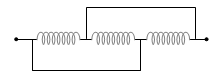
Pure inductance of 3.0 H is connected as shown below. The equivalent inductance of the circuit is
|
(a) 1 H |
(b) 2 H |
(c) 3 H |
(d) 9 H |
The equivalent resistance of the circuit shown in the figure is

|
(a) 8 W |
(b) 6 W |
(c) 5 W |
(d) 4 W |
A parallel plate condenser is connected with the terminals of a battery. The distance between the plates is 6mm. If a glass plate (dielectric constant K = 9) of 4.5 mm is introduced between them, then the capacity will become
|
(a) 2 times |
(b) The same |
(c) 3 times |
(d) 4 times |
In Bohr’s model, if the atomic radius of the first orbit is  , then the radius of the fourth orbit is
|
(a) |
(b) 4 |
(c) |
(d) 16 |
What will be the angle of diffracting for the first minimum due to Fraunhoffer diffraction with sources of light of wave length 550 nm and slit of width 0.55 mm
|
(a) 0.001 rad |
(b) 0.01 rad |
(c) 1 rad |
(d) 0.1 rad |
In Bohr's model of hydrogen atom, let PE represents potential energy and TE the total energy. In going to a higher level
|
(a) PE decreases, TE increases |
(b) PE increases, TE increases |
|
(c) PE decreases, TE decreases |
(d) PE increases, TE decreases |
