MCQ
Identify the quantity which changes when a charged particle moves through a magnetic field?
- AEnergy
- BMass
- CSpeed
- DDirection of motion
Explanation:
When a charged particle moves through a magnetic field it suffers a change in its direction of motion.
Generate a complete, print-ready paper with questions like this in minutes — across 16+ boards, with answer keys.
The time period of a thin bar magnet in earth’s magnetic field is T. If the magnet is cut into two equal parts perpendicular to its length, the time period of each part in the same field will be
|
(a) |
(b) T |
(c) |
(d) 2T |
Compton effect shows that
|
(a) X-rays are waves |
(b) X-rays have high energy |
|
(c) X-rays can penetrate matter |
(d) Photons have momentum |
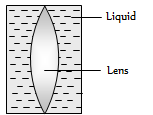
Shown in the figure here is a convergent lens placed inside a cell filled with a liquid. The lens has focal length + 20 cm when in air and its material has refractive index 1.50. If the liquid has refractive index 1.60, the focal length of the system is
|
(a) + 80 cm |
(b) – 80 cm |
(c) – 24 cm |
(d) –100 cm |
The momentum of a photon is 2  gm-cm/sec. Its energy is
|
(a) 0.61 |
(b) 2.0 |
(c) 6 |
(d) 6 |
A straight conductor carries a current of 5A. An electron travelling with a speed of 5  parallel to the wire at a distance of 0.1m from the conductor, experiences a force of
|
(a) 8 |
(b) 3.2 |
(c) 8 |
(d) 1.6 |
The main source of solar energy is
|
(a) Fission reactions |
(b) Fusion reactions |
|
(c) Chemical reactions |
(d) Combustion reactions |
The most penetrating radiation out of the following is
| (a) X-rays | (b) β -rays |
(c) α - particles |
(d) γ - rays |


