MCQ
Identify the similarity between isotopes of the same element.
- AThey have the same particles in the nucleus.
- BThey are equally abundant in nature.
- CThey have the same number of protons
- DThey have the same mass.
Explanation:
Isotopes of the same element must have same number of protons but different number of neutrons and hence they have different mass.
Also the isotopes of same element are not equally abundant in nature.
Generate a complete, print-ready paper with questions like this in minutes — across 16+ boards, with answer keys.
If  is the intensity of the principal maximum in the single slit diffraction pattern, then what will be its intensity when the slit width is doubled
|
(a) |
(b) |
(c) 2 |
(d) 4 |
If an electron and a positron annihiliate, then the energy released is
|
(a) 3.2 |
(b) 1.6 |
(c) 4.8 |
(d) 6.4 |
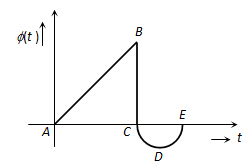
The graph Shows the variation in magnetic flux ∅(t) with time through a coil. Which of the statements given below is not correct
|
(a) There is a change in the direction as well as magnitude of the induced emf between B and D |
|
(b) The magnitude of the induced emf is maximum between B and C |
|
(c)There is a change in the direction as well as magnitude of induced emf between A and C |
|
(d) The induced emf is zero at B |
If resistance of voltmeter is 10000 W and resistance of ammeter is 2 W then find R when voltmeter reads 12V and ammeter reads 0.1 A
|
(a) 118 W |
(b) 120 W |
(c) 124 W |
(d) 114W |
The ratio of specific charge of an α -particle to that of a proton is
|
(a) 2 : 1 |
(b) 1 : 1 |
(c) 1 : 2 |
(d) 1 : 3 |
Assertion : The lightening conductor at the top of high building has sharp pointed ends.
Reason : The surface density of charge at sharp points is very high resulting in setting up of electric wind.
|
(a) If both assertion and reason are true and the reason is the correct explanation of the assertion. |
|
(b) If both assertion and reason are true but reason is not the correct explanation of the assertion. |
|
(c) If assertion is true but reason is false. |
|
(d) If the assertion and reason both are false. |
Assertion : A direct current flows through a metallic rod, produced magnetic field only outside the rod.
Reason : There is no flow of charge carriers inside the rod.
|
(a) If both assertion and reason are true and the reason is the correct explanation of the assertion. |
|
(b) If both assertion and reason are true but reason is not the correct explanation of the assertion. |
|
(c) If assertion is true but reason is false. |
|
(d) If the assertion and reason both are false. |

