Question
Identify the type of materials which develop electric currents in them, when an electric field is applied.

Answer

  1. Conductors
Explanation:
When an electric field is applied across the ends of conductors, the electrons begin to move under the action of the electric field. The flow of electrons constitutes electric current through the conductor.

Need a full question paper?

Generate a complete, print-ready paper with questions like this in minutes — across 16+ boards, with answer keys.
Start Generating Free

Similar questions

If mean wavelength of light radiated by $100 W$ lamp is $5000 \mathring A ,$ then number of photons radiated per second are
Two sources of monochromatic light in coherent, when their :
Inductive reactance of a coil is expressed in.
An LR circuit with a battery is connected at t = 0. Which of the following quantities is not zero just after the connection?
  1. Current in the circuit.
  2. Magnetic field energy in the inductor.
  3. Power delivered by the battery.
  4. Emf induced in the inductor.
The thinnest bubble film in air that can possibly strongly reflect red light because of constructive interference makes up a certain bubble. How could we create the thinnest bubble film that will strongly reflect purple light?
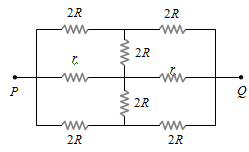
The effective resistance between points $P$ and $Q$ of the electrical circuit shown in the figure is
Which of the following statements is/ are correct for equipotential surface ?
  1. The potential at all the points on an equipotential surface is same.
  2. Equipotential surfaces never intersect each other.
  3. Work done in moving a charge from one point to other on an equipotential surface is zero.
Which of the following is true?
The incorrect statement regarding the lines of force of the magnetic field B is(a) Magnetic intensity is a measure of lines of force passing through unit area held normal to it(b) Magnetic lines of force form a close curve(c) Inside a magnet, its magnetic lines of force move from north pole of a magnet towards its south pole(d) Due to a magnet magnetic lines of force never cut each other


A conductor with a positive charge (a) Is always at +ve  potential(b) Is always at zero potential(c) Is always at negative potential(d) May be at +ve, zero or -ve potential