Question
Identify the wrong statement describing the color code for carbon resistors.

Answer

  1. The third band indicates the third significant figure.
Explanation:
The third band indicates the power of ten with which the first and second significant figures must be multiplied to get the resistance value in ohms. All the other statements are valid.

Need a full question paper?

Generate a complete, print-ready paper with questions like this in minutes — across 16+ boards, with answer keys.
Start Generating Free

Similar questions

The separation between the plates of a charged parallel-plate capacitor is increased. Which of the following quantities will change?
  1. Charge on the capacitor.
  2. Potential difference across the capacitor.
  3. Energy of the capacitor.
  4. Energy density between the plates.
The most suitable metal for making permanent magnets is:
With increase in frequency of an A.C. supply, the inductive reactance.
A symmetric double convex lens is cut in two equal parts by a plane containing the principal axis. If the power of the original lens was $4D,$ the power of a divided lens will be$:$
A coil of wire of resistance 50Ω  is embedded in a block of ice. If a potential difference of 210 V is applied across the coil, the amount of ice melted per second will be(a) 4.12 gm(b) 4.12 kg(c) 3.68 kg(d) 2.625 gm
       
The continuous X-rays spectrum produced by an X-ray machine at constant voltage has(a) A maximum wavelength(b) A minimum wavelength(c) A single wavelength(d) A minimum frequency
   
   
The direction of electric field is from:
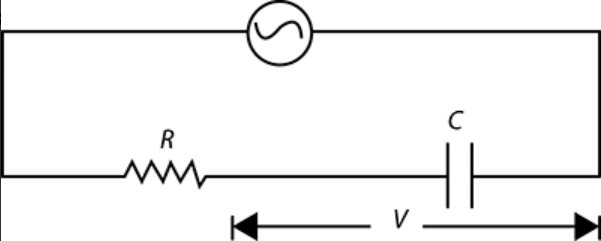
A resistance R and a capacitor C are joined to a source of AC of constant e.m.f and variable frequency. The potential difference across C is V. If the frequency of AC is gradually increased, V will
Image
In a thermocouple, the temperature that does not depend on the temperature of the cold junction is called(a) Neutral temperature(b) Temperature of inversion(c) Both the above(d) None of the above
   
   
Which of the following is NOT a postulate of Bohr's model of the hydrogen atom?