MCQ
Identify the wrong statement in the following.
  • Amongst isoelectronic species, smaller the positive charge on the cation, smaller is the ionic radius.
  • B
    Amongst isoelectronic species, greater the negative charge on the anion, larger is the ionic radius.
  • C
    Atomic radius of the elements increases as one moves down the first group of the periodic table.
  • D
    Atomic radius of the elements decreases as one moves across from left to right in the $2^{nd}$ period of the periodic table.
Answer

Correct option: A.
Amongst isoelectronic species, smaller the positive charge on the cation, smaller is the ionic radius.
a
Atomic radius of the elements decreases across a period from left to right due to increase in effective nuclear charge. On moving down a group, since, number of shells increases, so atomic radius increases

Amongst isoelectronic species ionic radius increases with increase in negative charge of decrease in positive charge

Need a full question paper?

Generate a complete, print-ready paper with questions like this in minutes — across 16+ boards, with answer keys.

Start Generating Free

Similar questions

$Image$

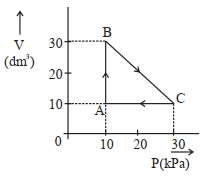
An ideal gas undergoes a cyclic transformation starting from the point $\mathrm{A}$ and coming back to the same point by tracing the path $\mathrm{A} \rightarrow \mathrm{B} \rightarrow \mathrm{C} \rightarrow \mathrm{A}$ as shown in the diagram. The total work done in the process is____ $J$.

Identify the correct order of the size of the following:
Identify the pair in which the geometry of the species is $T-$ shape and square pyramidal, respectively
Which amongst the following options is the correct relation between change in enthalpy and change in internal energy?
Artificial sweetner that is unstable at cooking temperature is
The ratio of the energy of the electrons in ground state of hydrogen to the electrons in first excited state of $Be^{3+}$ is :
$C{H_3}C{O_2}Et + {(C{H_2})_5}{(MgBr)_2}\xrightarrow[{(2){H^ + }}]{}\mathop {{C_7}{H_{14}}O}\limits_{(A)} $ ; compound $(A)$ will be
Assign $A, B, C, D$ from given type of reaction.

A for precipitate formation reaction.

B for precipitate dissolution reaction.

C for precipitate exchange reaction.

D for no reaction.

${P_4} + NaOH \longrightarrow P{H_3} \uparrow  + Na{H_2}P{O_2}$

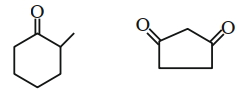
Total number of compounds with Chiral carbon atoms from following is___________.   $IMAGE$

$ \mathrm{CH}_3-\mathrm{CH}_2-\mathrm{CH}\left(\mathrm{NO}_2\right)-\mathrm{COOH} $

$ \mathrm{CH}_3-\mathrm{CH}_2-\mathrm{CHBr}-\mathrm{CH}_2-\mathrm{CH}_3 $

$ \mathrm{CH}_3-\mathrm{CH}(\mathrm{I})-\mathrm{CH}_2-\mathrm{NO}_2 $

$ \mathrm{CH}_3-\mathrm{CH}_2-\mathrm{CH}(\mathrm{OH})-\mathrm{CH}_2 \mathrm{OH} $

$ \mathrm{CH}_3-\mathrm{CH}-\mathrm{CH}(\mathrm{I})-\mathrm{C}_2 \mathrm{H}_5 $

$RMgX\xrightarrow{{\begin{array}{*{20}{c}}
  O \\ 
  {||} \\ 
  {H - C - H} 
\end{array}}}$ $\begin{array}{*{20}{c}}
  {C{H_3} - CH - C{H_2} - OH} \\ 
  {|\,\,\,\,\,\,\,\,\,\,\,\,\,\,\,\,\,\,\,\,\,} \\ 
  {C{H_3}\,\,\,\,\,\,\,\,\,\,\,\,\,\,\,} 
\end{array}$ Find out $R$ in this reaction