MCQ
Identify $X, Y, Z$ from figure
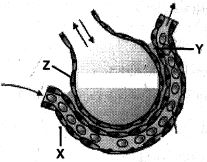
- A$X-$ $RBC,$ $Y-$ Blood capillary, $Z-$ Air
- ✓$X-$ Blood Capillary, $Y-$ Basement substance $Z-$ Alveolar wall
- C$X-$ Air, $Y-$ Alveolar cavity, $Z-RBC $
- D$X-$ Basement substance, $Y-$ Air, $Z-RBC$
Generate a complete, print-ready paper with questions like this in minutes — across 16+ boards, with answer keys.
$(i)$ It is ten enzymatic reactions that convert a six-carbon molecule to a three carbon pyruvate and result in a net gain of $2\, ATP$ molecules.
$(ii)$ Glucose undergoes partial oxidation to form one molecule of pyruvic acid.
$(iii)$ Glucose is phosphorylated to give rise to glucose $- 6 -$ phosphate by the activity of the enzyme phosphofructokinase.
$(iv)$ The scheme of glycolysis was given by Gustav Embden, Otto Morrison, and $J$. Parnas and is often referred to as the $EMP$ pathway.
$(v)$ $ATP$ is utilized at two steps: first in the conversion of glucose into glucose $6-$ phosphate and second in the conversion of fructose $- 6-$ phosphate to fructose $1, 6-$ disphosphate
|
Column $I$ (Epithelial tissue) |
Column $II$ (Location) |
| $A.$ Cuboidal | $I.$ Epidermis of skin |
| $B.$ Ciliated | $II.$ Inner lining of blood vessels |
| $C.$ Columnar | $III.$ Inner surface of gall bladder |
| $D.$ Squamous | $IV.$ Inner lining of fallopian tube |
| $E.$ Keratinized squamous | $V.$ Lining of pancreatic duct |