MCQ
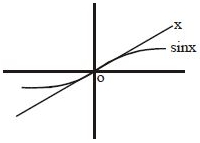
If $0 < x < \frac{\pi }{2},$ then
  • A
    $\frac{2}{\pi } > \frac{{\sin \,x}}{x}$
  • $\frac{{\sin \,x}}{x} < 1$
  • C
    $\frac{{\sin \,x}}{x} < 0.5$
  • D
    $\frac{{\sin \,x}}{x} > 1$

Answer

Correct option: B.
$\frac{{\sin \,x}}{x} < 1$
b
For $x>0$

$x>\sin x$

$\frac{\sin x}{x}<1$

Need a full question paper?

Generate a complete, print-ready paper with questions like this in minutes — across 16+ boards, with answer keys.

Start Generating Free

Similar questions

Let $f: R \rightarrow R$ be the function $f(x)=\left(x-a_1\right)\left(x-a_2\right)$ $+\left(x-a_2\right)\left(x-a_3\right)+\left(x-a_3\right)\left(x-a_1\right)$ with $a_1, a_2, a_3 \in R$.Then, $f(x) \geq 0$ if and only if
If one of the roots of the equation ${x^2} + ax + b = 0$ and ${x^2} + bx + a = 0$ is coincident, then the numerical value of $(a + b)$ is
If the solution for $\theta $ of $\cos p\theta + \cos q\theta = 0,\;p > 0,\;q > 0$ are in $A.P.$, then the numerically smallest common difference of $A.P.$ is
A man $ 2 $ metre high walks at a uniform speed  $5$  metre/hour away from a lamp post $ 6$ metre high. The rate at which the length of his shadow increases is
Statement $1$ : The only circle having radius $\sqrt {10} $ and a diameter along line $2x + y = 5$ is $x^2 + y^2 - 6x +2y = 0$.
Statement $2$ : $2x + y = 5$ is a normal to the circle $x^2 + y^2 -6x+2y = 0$.
If $\phi(x)=\frac{1}{\sqrt{x}} \frac{\pi}{4} \int \limits_0^x\left(4 \sqrt{2} \sin t-3 \phi^{\prime}(t)\right) d t, \quad x > 0$ then $\phi^{\prime}\left(\frac{\pi}{4}\right)$ is equal to :
If the solution curve of the differential equation $\frac{d y}{d x}=\frac{x+y-2}{x-y}$ passes through the point $(2,1)$ and $( k +1,2), k >0$, then.
Two orthogonal circles are such that area of one is twice the area of other. If radius of smaller circle is $r$, then distance between their centers will be -
The largest value of $r$ for which the region represented by the set $\{ \omega \, \in \,C|\,\omega \, - \,4\, - \,i|\, \le \,r\} $ is contained in the region represented by the set $(z\, \in \,c/|\,z\, - \,1\,\,\left|  \le  \right|\,z\, + \,i|),$ is equal to
If $cos\, (\alpha + \beta ) = 0$ then $sin \,(\alpha + 2\beta ) =$