MCQ
If $(1 + \sin A)(1 + \sin B)(1 + \sin C)$$ = (1 - \sin A)(1 - \sin B)(1 - \sin C),$ then each side is equal to
  • A
    $ \pm \sin A\sin B\sin C$
  • $ \pm \cos A\cos B\cos C$
  • C
    $ \pm \sin A\cos B\cos C$
  • D
    $ \pm \cos A\sin B\sin C$

Answer

Correct option: B.
$ \pm \cos A\cos B\cos C$
b
(b) Multiplying both sides by $(1 - \sin A)(1 - \sin B)(1 - \sin C)$, 

we have, $(1 - {\sin ^2}A)(1 - {\sin ^2}B)(1 - {\sin ^2}C)$ 

$ = {(1 - \sin A)^2}{(1 - \sin B)^2}{(1 - \sin C)^2}$

==> $(1 - \sin A)(1 - \sin B)(1 - \sin C) = \pm \cos A\cos B\cos C$

Similarly, $(1 + \sin A)(1 + \sin B)(1 + \sin C) = \pm \cos A\cos B\cos C$.

Need a full question paper?

Generate a complete, print-ready paper with questions like this in minutes — across 16+ boards, with answer keys.

Start Generating Free

Similar questions

Let $R$ be a relation from $A = \{2,3,4,5\}$ to $B = \{3,6,7,10\}$ defined by $R = \{(a,b) |$ $a$ divides $b, a \in A, b \in B\}$, then number of elements in $R^{-1}$ will be-
Let $u = \int\limits_0^1 {\frac{{\ln (x + 1)}}{{{x^2} + 1}}\,dx} $ and $v = \int\limits_0^{\frac{\pi }{2}} {\ln (\sin 2x)\,dx} $ then
If $\int \frac{1}{a^2 \sin ^2 x+b^2 \cos ^2 x} d x=\frac{1}{12} \tan ^{-1}(3 \tan x)+$
constant, then the maximum value of $a \sin x+b \cos x$, is :
Solution of differential equation $\frac{{dy}}{{dx}} = \sin x + 2x$, is
Solve $\sin ^{-1}(1-x)-2 \sin ^{-1} x=\frac{\pi}{2},$ then $x$ is equal to
If all interior angle of quadrilateral are in $A.P.$ If common difference is $10^o$, then find smallest angle ? .............. $^o$
A ray of light travelling along the line $x = 2$ strikes a parabolic mirror with equation $y^2 -2y -4x + 5 = 0$ and gets reflected from its surface then equation of reflected ray may be
There are three bags X, Y and Z. Bag X contains 5 one-rupee coins and 4 five-rupee coins; Bag Y contains 4 one-rupee coins and 5 five-rupee coins and Bag Z contains 3 one-rupee coins and 6 five-rupee coins. A bag is selected at random and a coin drawn from it at random is found to be a one-rupee coin. Then the probability, that it came from bag Y, is :
The solution of differential equation

$\frac{dy}{dx}=\frac{(sin y + e^x )}{( lny- x cos y)}$ is -
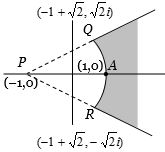
$PQ$ and $PR$ are two infinite rays. $QAR$ is an arc. Point lying in the shaded region excluding the boundary satisfies