Question
If $2 \log x + 1 = \log$ $360$, find: $\log (3 x^2 - 8)$

Answer

$\log \left(3 x^2-8\right) $
$2 \log x+1=\log 360 $
$\Rightarrow \log x^2+\log 10=\log 360 $
$\Rightarrow \log \left(10 x^2\right)=\log 360 $
$\Rightarrow 10 x^2=360 $
$\Rightarrow x^2=\frac{360}{10}=36 $
$\Rightarrow x=\sqrt{36}= \pm 6$
As negative value is rejected,
$\therefore x =6 $
$\therefore \log \left(3 x ^2-8\right) $
$=\log \left\{3(6)^2-8\right\} $
$=\log (108-8) $
$=\log 100 $
$=\log 10^2 $
$=2 \log 10 $
$=2 \times 1$
$= 2.$

Need a full question paper?

Generate a complete, print-ready paper with questions like this in minutes — across 16+ boards, with answer keys.
Start Generating Free

Similar questions

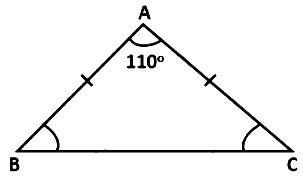
Find the interior angles of the following triangles:
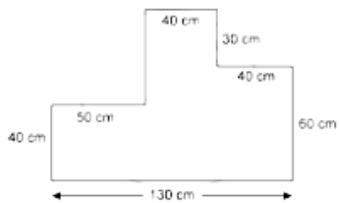
The given figure is a cross$-$section of a victory stand used in sports. All measurements are in centimetres. Assume all angles in the figure are right angles. If the width of the stand is $60 \ cm$, find The space it occupies in $cm^3.$
Image
Prove that the following number is irrational: $3 - \sqrt{2}$
In a right$-$angled $\triangle ABC$, if $\angle B = 90^\circ , AB - BC = 2 \ cm; AC - BC = 4$ and its perimeter is $24 \ cm,$ find the area of the triangle.
The net difference between selling a shirt at a profit of $10\%$ and $15\%$ is $Rs.80$. What are the selling prices?
The cross-section of a piece of metal $4$ m in length is shown below. Calculate :


$(i)$ The area of the cross$-$section;$(ii)$ The volume of the piece of metal in cubic centimeters.If $1$ cubic centimeter of the metal weighs $6.6\ g$, calculate the weight of the piece of metal to the nearest $kg.$
The value of a mobile depreciated by $5\%$ per year during the first two years and $10\%$ per year during the third year. Express the total depreciation of the value of the mobile in percent during the three years.
Construct a triangle using the given data: Perimeter of triangle is $10.6 \ cm$, and the base angles are $60^\circ $ and $45^\circ $
In an isosceles $\triangle ABC; AB = AC$ and $D$ is the point on $BC$ produced.Prove that: $AD^2= AC^2+ BD.CD$.