MCQ
If $4.0 \,gm $ $NaOH$ is present in $1$ litre solution, then its $pH$ will be
  • A
    $6$
  • $13$
  • C
    $18$
  • D
    $24$

Answer

Correct option: B.
$13$
(b) $[NaOH]=0{.4}/{40\,\,{mole}/{l.}\;=0.1\,M}\;$

$[O{H^ - }] = {10^{ - 1}}M$, $[{H^ + }] = {10^{ - 13}}M$,  $pH = 13$

Need a full question paper?

Generate a complete, print-ready paper with questions like this in minutes — across 16+ boards, with answer keys.
Start Generating Free

Similar questions

For the process to occur under adiabatic conditions, the correct condition is:
In the equilibrium  $ HClO‌‌_4+H‌‌_2O $ $\rightleftharpoons$ $ H_2O^+$+$ClO_4^ - $
The empirical formula of a compound is CH2. One mole of this compound has a mass of 42g. Its molecular formula is a:
The reaction of calcium with water is represented by the equation $Ca + 2H_2O \to  Ca(OH)_2 + H_2$ What volume of $H_2$ at $STP$ would be liberated when $8\, gm$ of calcium completely reacts with water? .......... $\mathrm{cm}^{-3}$
Maximum number of electrons in a subshell with l = 3 and n = 4 is ________.
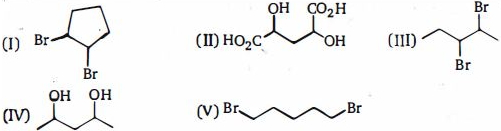
A compound was synthesized by a student, but its structure was not identified.  However, his wonderfully helpful instructor told him that it was a meso compound with $5$ carbons and $2$ stereogenic centers. Which of the following structures  should the student consider as possibilities for his compound ?
What is the oxidation number of chlorine in $\text{ClO}^-_3$​?
The structure which represents the molecular structure more accurately is called:
The difference between the radii of $3^{\text {rd }}$ and $4^{\text {th }}$ orbits of $Li ^{2+}$ is $\Delta R _{1}$. The difference between the radii of $3^{\text {rd }}$ and $4^{\text {th }}$ orbits of $He ^{+}$ is $\Delta R _{2}$. Ratio $\Delta R _{1}: \Delta R _{2}$ is :
A solution of $D \,(+)$ $- 2-$chloro$-2-$phenylethane in toluene racemises slowly in the presence of small amount of $SbC{l_5},$ due to the formation of