MCQ
If $a = 2i + 5j$ and $b = 2i - j,$ then the unit vector along $a+b$   will be
  • A
    $\frac{{i - j}}{{\sqrt 2 }}$
  • B
    $i + j$
  • C
    $\sqrt 2 (i + j)$
  • $\frac{{i + j}}{{\sqrt 2 }}$

Answer

Correct option: D.
$\frac{{i + j}}{{\sqrt 2 }}$
d
(d) $a + b = 4i + 4j,$ therefore unit vector $\frac{{4\,(i + j)}}{{\sqrt {32} }} = \frac{{i + j}}{{\sqrt 2 }}.$

Need a full question paper?

Generate a complete, print-ready paper with questions like this in minutes — across 16+ boards, with answer keys.
Start Generating Free

Similar questions

Let $A =\{1,2,3,4,5,6,7\}$. Then the relation $R =$ $\{( x , y ) \in A \times A : x + y =7\}$ is
If $y=y(x)$ is the solution of the differential equation $\frac{d y}{d x}+2 y=\sin (2 x), y(0)=\frac{3}{4}$, then $\mathrm{y}\left(\frac{\pi}{8}\right)$ is equal to :
$\int_0^{2a} {\frac{{f(x)}}{{f(x) + f(2a - x)}}\,dx = } $
Let $\mathrm{A}=\{1,2,3,4,5\}$. Let $\mathrm{R}$ be a relation on $\mathrm{A}$ defined by $x R y$ if and only if $4 x \leq 5 y$. Let $m$ be the number of elements in $\mathrm{R}$ and $\mathrm{n}$ be the minimum number of elements from $\mathrm{A} \times \mathrm{A}$ that are required to be added to $\mathrm{R}$ to make it a symmetric relation. Then $m+n$ is equal to:
Let $A=\left[\begin{array}{ccc}2 & 1 & 0 \\ 1 & 2 & -1 \\ 0 & -1 & 2\end{array}\right]$. If $|\operatorname{adj}(\operatorname{adj}(\operatorname{adj} 2 A))|=(16)^{ n }$, then $n$ is equal to
Considering only the principal values of inverse trigonometric functions, the number of positive real values of $x$ satisfying $\tan ^{-1}(x)+\tan ^{-1}(2 x)=\frac{\pi}{4}$ is:
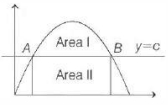
The figure shows a portion of the graph $y=2 x-4 x^3$.The line $y=c$ is such that the areas of the regions marked $I$ and $II$ are equal. If $a, b$ are the $x$-coordinates of $A, B$ respectively, then $a+b$ equals
If the function f : R → R be such that f(x) = x - [x], where [x] denotes the greatest integer less than or equal to x, then f-1(x) is:
  1. $\frac{1}{\text{x}-[\text{x}]}$
  2. [x] - x
  3. Not defined
  4. None of these.
Let $f(x) = x^3 + px + 1$ and consider following three statements Then

$(i)$ for $p \geqslant  0$ , $f(x) = 0$ has one negative root and $f(x)$ is monotonic

$(ii)$ for $-1 < p < 0$ , $f(x)$ = $0$ has one negative root and $f(x)$ is nonmonotonic
$(iii)$ for $p < 0$ , $f(x)$ = $0$ has three real and distinct roots.

If $\vec u$ and $\vec v$ are unit vectors and $\theta$ is the acute angle between them, then $2 \vec u \times 3 \vec v$ is a unit vector for