Question
If A and B are two events associated to a random experiment such that $\text{P}(\text{A}\cap\text{B})=\frac{7}{10}$ and $\text{P(B)}=\frac{17}{20}$, then P(A|B) =
  1. $\frac{14}{17}$
  2. $\frac{17}{20}$
  3. $\frac{7}{8}$
  4. $\frac{1}{8}$

Answer

  1. $\frac{14}{17}$

Solution:

$\text{P}(\text{A}\cap\text{B})=-\frac{7}{10},\text{P(B)}=\frac{17}{20}$

$\text{P}\Big(\frac{\text{A}}{\text{B}}\Big)=\frac{\text{P}(\text{A}\cap\text{B})}{\text{P(B)}}$

$\text{P}\Big(\frac{\text{A}}{\text{B}}\Big)=\frac{\frac{7}{10}}{\frac{17}{20}}=\frac{14}{17}$

Need a full question paper?

Generate a complete, print-ready paper with questions like this in minutes — across 16+ boards, with answer keys.

Start Generating Free

Similar questions

The differential equation $x{\left( {\frac{{{d^2}y}}{{d{x^2}}}} \right)^3} + {\left( {\frac{{dy}}{{dx}}} \right)^4} + y = {x^2}$ is of
Choose the correct answer from the given four options.

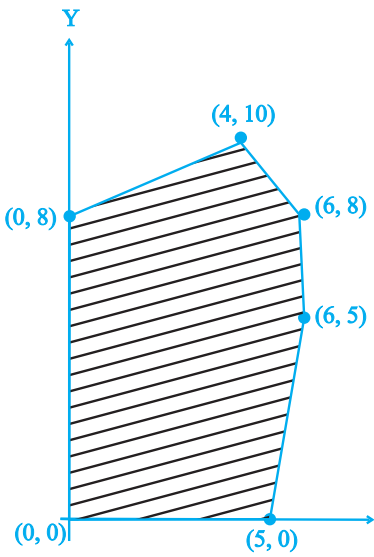
The feasible solution for a LPP shown in Fig. 12.12. Let z = 3x - 4y be objective functio. (Maximum value of Z + Minimum value of Z) is equal to:
  1. 13.
  2. 1.
  3. -13.
  4. -17.
The solution of the differential equation $\sqrt {a + x} \frac{{dy}}{{dx}} + xy = 0$is
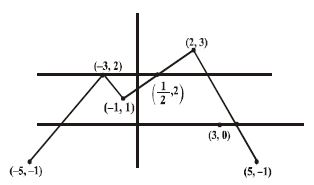
The graph of $y = f(x)$ is shown then number of solutions of the equation $f(f(x)) =2$ is
Let $f:(1,3) \rightarrow \mathrm{R}$ be a function defined by

$f(\mathrm{x})=\frac{\mathrm{x}[\mathrm{x}]}{1+\mathrm{x}^{2}},$ where $[\mathrm{x}]$ denotes the greatest

integer $\leq \mathrm{x} .$ Then the range of $f$ is

Let $f(x)=\max \left\{3, x^2, \frac{1}{x^2}\right\}$ for $\frac{1}{2} \leq x \leq 2$. Then, the value of the integral $\int_{1 / 2}^2 f(x) d x$ is
Let $f : R \rightarrow  R\ f(x) = x^3 -3x^2 + 3x\ -2$ , then $f^{-1}(x)$ is given by
A square piece of tin of side $30\,cm$ is to be made into a box without top by cutting a square from each corner and folding up the flaps to form a box. If the volume of the box is maximum, then its surface area (in $cm ^2$ ) is equal to $............$.
If $A=\left[\begin{array}{ccc}1 & 0 & 0 \\ 0 & 1 & 0 \\ 59 & 69 & -1\end{array}\right]$, then $A^{-1}$
A box $B_1$ contains $1$ white ball, $3$ red balls and $2$ black balls. Another box $B_2$ contains $2$ white balls, $3$ red balls and $4$ black balls. A third bo $B _2$ contains $3$ white balls, $4$ red balls and $5$ black balls.

$1.$ If $1$ ball is drawn from each of the boxes $B_1, B_2$ and $B_3$, the probability that all $3$ drawn balls are of the same colour is

$(A)$ $\frac{82}{648}$ $(B)$ $\frac{90}{648}$ $(C)$ $\frac{558}{648}$ $(D)$ $\frac{566}{648}$

$2.$ If $2$ balls are drawn (without replacement) from a randomly selected box and one of the balls is white and the other ball is red, the probability that these $2$ balls are drawn from bo $B _2$ is

$(A)$ $\frac{116}{181}$ $(B)$ $\frac{126}{181}$ $(C)$ $\frac{65}{181}$ $(D)$ $\frac{55}{181}$

Give the answer question $1$ and $2.$