MCQ
If A and B are two events, then $\text{P}(\overline{\text{A}}\cap\text{B})=$
  • A
    $\text{P}(\overline{\text{A}})\text{ P}(\overline{\text{B}})$
  • B
    $1-\text{P}(\text{A})-\text{P}(\text{B})$
  • C
    $\text{P}(\text{A})+\text{P}(\text{B})-\text{P}(\text{A}\cap\text{B})$
  • D
    $\text{P}(\text{B})-\text{P}(\text{A}\cap\text{B})$

Answer

  1. $\text{P}(\text{B})-\text{P}(\text{A}\cap\text{B})$

Solution:

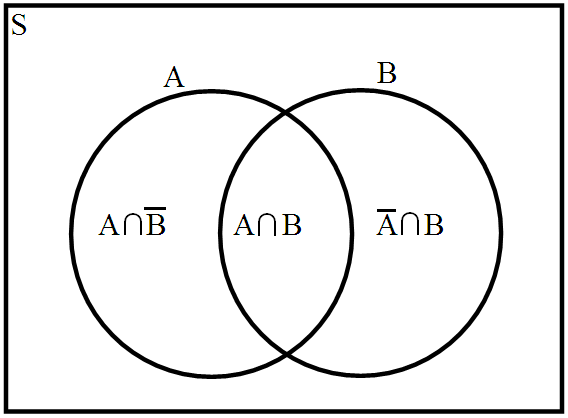
From the diagram, we get $\text{A}\cap\text{B}$ and $\overline{\text{A}}\cap\text{B}$ are mutually exclusive events such that $(\text{A}\cap\text{B})\cup(\overline{\text{A}}\cap\text{B})=\text{B}.$ therefore by

$\text{P}(\text{A}\cap\text{B})+\text{P}(\overline{\text{A}}\cap\text{B})=\text{P(B)}$

$\therefore\ \text{P}(\overline{\text{A}}\cap\text{B})=\text{P(B)}-\text{P}(\text{A}\cap\text{B})$

Need a full question paper?

Generate a complete, print-ready paper with questions like this in minutes — across 16+ boards, with answer keys.

Start Generating Free

Similar questions

Let $f:(0,2) \rightarrow R$ be defined as $f( x )=\log _{2}\left(1+\tan \left(\frac{\pi x }{4}\right)\right)$ Then, $\lim _{n \rightarrow \infty} \frac{2}{n}\left(f\left(\frac{1}{n}\right)+f\left(\frac{2}{n}\right)+\ldots+f(1)\right)$ is equal to
The function $\text{f(x)}=|\cos\text{x}|$ is:
  1. Differentiable at$\text{x}=(2\text{n}+1)\frac{\pi}{2},\text{n}\in\text{Z}$
  2. Continuous but not differentiable at $\text{x}=(2\text{n}+1)\frac{\pi}{2},\text{n}\in\text{Z}$
  3. Neither differentiable nor continuous at $\text{x}=\text{n}\in\text{Z}$
  4. None of these.
For any $3 \times 3$ matrix $M$, let $| M |$ denote the determinant of $M$. Let

$E=\left[\begin{array}{ccc}1 & 2 & 3 \\ 2 & 3 & 4 \\ 8 & 13 & 18\end{array}\right], P=\left[\begin{array}{lll}1 & 0 & 0 \\ 0 & 0 & 1 \\ 0 & 1 & 0\end{array}\right]$ and $F=\left[\begin{array}{ccc}1 & 3 & 2 \\ 8 & 18 & 13 \\ 2 & 4 & 3\end{array}\right]$

If $Q$ is a nonsingular matrix of order $3 \times 3$, then which of the following statements is (are) $TRUE$?

$(A)$F $=P E P$ and $P^2=\left[\begin{array}{lll}1 & 0 & 0 \\ 0 & 1 & 0 \\ 0 & 0 & 1\end{array}\right]$

$(B)$ $\left| EQ + PFQ ^{-1}\right|=| EQ |+\left| PFQ ^{-1}\right|$

$(C)$ $\left|( EF )^3\right|>| EF |^2$

$(D)$ Sum of the diagonal entries of $P ^{-1} EP + F$ is equal to the sum of diagonal entries of $E + P ^{-1} FP$
The domain of function $\cos ^{-1}(2 x-3)$ is :
Let $f(x)=2 \cos ^{-1} x+4 \cot ^{-1} x-3 x^{2}-2 x+10, x \in[-$ $1,1]$. If $[ a , b ]$ is the range of the function then $4 a -$ $b$ is equal to
A bag contains $30$ white balls and $10$ red balls. $16$ balls are drawn one by one randomly from the bag with replacement. If $X$ be the number of white balls drawn, then $\left( {\frac{{{\rm{mean\, of\, X}}}}{{{\rm{standard\, deviation\, of\, X}}}}} \right)$ is equal to
The value of $ \cos { \left( \tan ^{ -1 }{ \tan { 4 } } \right) }$ is-
  1. $ \frac { 1 }{ \sqrt { 17 } }$
  2. $ \frac { 1 }{ \sqrt {- 17 } }$
  3. $ \frac { 1 }{ \sqrt {- 14 } }$
  4. $ -\cos 4$
The matrix $\left[\begin{array}{lll}1 & 0 & 0 \\ 0 & 2 & 0 \\ 0 & 0 & 0\end{array}\right]$ is a/an
$\int_{}^{} {\frac{{dx}}{{(x + 1)(x + 2)}} = } $
If S = [Sij] is a scalar matrix such that Sij = k and A is a square matrix of the same order, then AS = SA = ?
  1. Ak
  2. k + A
  3. kA
  4. kS