Question
If $A : B = 7 : 5$ and $B : C = 9 : 14,$ find $A : C.$

Answer

$\text{A}:\text{B}=7:5$
$\Rightarrow\frac{\text{A}}{\text{B}}=\frac{7}{5}$
$\text{B}:\text{C}=9:14$
$\Rightarrow\frac{\text{B}}{\text{C}}=\frac{9}{14}$
Multiplying we get, $\therefore\frac{\text{A}}{\text{B}}\times\frac{\text{B}}{\text{C}}=\frac{7}{5}\times\frac{9}{14}$
$\Rightarrow\frac{\text{A}}{\text{C}}=\frac{9}{10}$
$\therefore\text{A}:\text{C}=9:10$

Need a full question paper?

Generate a complete, print-ready paper with questions like this in minutes — across 16+ boards, with answer keys.

Start Generating Free

Similar questions

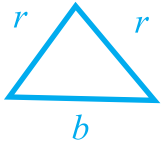
A triangle is made up of $2$ red sticks and $1$ blue sticks .

The length of a red stick is given by $r$ and that of a blue stick is given by $b.$ Using this information, write an expression for the total length of sticks in the pattern given below:
The following observations have been arranged in ascending order. If the median of the data is 63, find the value of x: 29, 32, 48, 50, x, x + 2, 72, 78, 84, 95
Simplify the following and express the result as a rational number in standard form:
$\frac{-19}{36} \times 16$
one slde of a parallelogram ts $l8 \ cm$ long and lts area ls $153 \mathrm{~cm}^2$. Ftnd the distance of the glven slde from lts opposlte side.
Subtract: $\frac{-13}{9}\text{ from }0$
Add the following rational numbers: $\frac{-2}{5}\text{ and }\frac{3}{4}$
A cowherd took all his cows to graze in the fields. The cows can go to a crossing with 3 gates. An equal number of cows passed through each gate. Later, at another crossing with 5 gates again an equal number of cows passed through each gate. The same happened at the third crossing with 7 gates. If the cowherd had fewer than 200 cows, how many cows did he have? (Based on the folklore mathematics from Karnataka).
Consider a group of 17 students with the following heights (in cm): 106, 110, 123, 125, 117, 120, 112, 115, 110, 120, 115, 102, 115, 115, 109, 115, 101. The sports teacher wants to divide the class into two groups so that each group has an equal number of students: one group has students with heights less than a particular height, and the other group has students with heights greater than the particular height. Suggest a way to do this. Can you guess the age of these students based on the tabular data in the ‘Telling Tall Tales’ section?
The product of two rational numbers is $\frac{-16}{2}.$ If one of the numbers is $\frac{-4}{3},$ find the other.
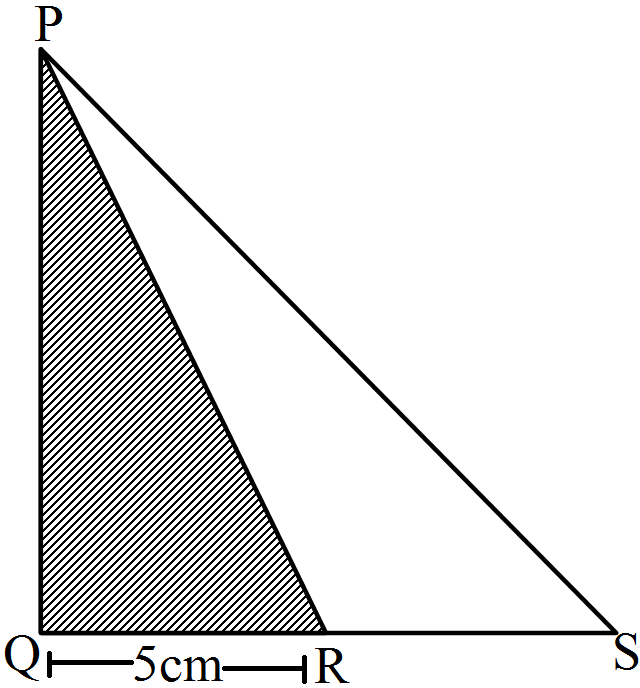
In Fig. area of $\triangle P Q R$ is $20 \mathrm{~cm}^2$ and area of $\triangle P Q S$ is $44 \mathrm{~cm}^2$. Find the length $R S$, if $P Q$ is perpendicular to $QS$ and $QR$ is $5\ cm.$