MCQ
If $a, b, c$  are mutually perpendicular unit vectors, then $|a + b + c|\,\, = $
  • $\sqrt 3 $
  • B
    $3$
  • C
    $1$
  • D
    $0$

Answer

Correct option: A.
$\sqrt 3 $
a
(a) Three mutually perpendicular unit vectors $ = a$, $b$ and $c$.

Therefore $|a|\, = \,|b|\, = \,|c|\, = 1$ and $a.b = b.c = c.a = 0$.

We know that

$|a + b + c{|^2} = (a + b + c)\,.\,(a + b + c) = \,\,|a{|^2} + |b{|^2}$

$ + |c{|^2} + 2(a\,.\,b\,\, + b\,.\,c\, + c\,.\,a) = 1 + 1 + 1 + 0 = 3$

or $|a + b + c|\, = \sqrt 3 .$

Need a full question paper?

Generate a complete, print-ready paper with questions like this in minutes — across 16+ boards, with answer keys.
Start Generating Free

Similar questions

The value of $C$ for which $P\,(X = k) = C{k^2}$ can serve as the probability function of a random variable $X$ that takes $0, 1, 2, 3, 4$ is
If ${A_1},\;{A_2}$ are the two $A.M.'s$ between two numbers $a$ and $b$ and ${G_1},\;{G_2}$ be two $G.M.'s$ between same two numbers, then $\frac{{{A_1} + {A_2}}}{{{G_1}.{G_2}}} = $
If $\sin ^{-1} \frac{\alpha}{17}+\cos ^{-1} \frac{4}{5}-\tan ^{-1} \frac{77}{36}=0,0 < \alpha < 13$, then $\sin ^{-1}(\sin \alpha)+\cos ^{-1}(\cos \alpha)$ is equal to $.........$.
Let $\alpha, \beta \in \mathrm{N}$ be roots of equation $\mathrm{x}^2-70 \mathrm{x}+\lambda=0$, where $\frac{\lambda}{2}, \frac{\lambda}{3} \notin \mathrm{N}$. If $\lambda$ assumes the minimum possible value, then $\frac{(\sqrt{\alpha-1}+\sqrt{\beta-1})(\lambda+35)}{|\alpha-\beta|}$ is equal to :
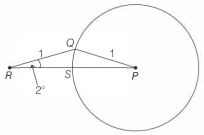
Suppose $Q$ is a point on the circle with centre $P$ and radius $1$, as shown in the figure, $R$ is a point outside the circle such that $Q R=1$ and $\angle Q R P=2^{\circ}$. Let $S$ be the point where the segment $R P$ intersects the given circle. Then, measure of $\angle R Q S$ equals $......^{\circ}$
If the area of the auxiliary circle of the ellipse $\frac{{{x^2}}}{{{a^2}}} + \frac{{{y^2}}}{{{b^2}}} = 1\left( {a > b} \right)$ is twice the area of the ellipse, then the eccentricity of the ellipse is
$\int_{}^{} {\frac{{f'(x)}}{{{{[f(x)]}^2}}}} \;dx = $
If $\mathrm{e}_{1}$ and $\mathrm{e}_{2}$ are the eccentricities of the ellipse, $\frac{\mathrm{x}^{2}}{18}+\frac{\mathrm{y}^{2}}{4}=1$ and the hyperbola, $\frac{\mathrm{x}^{2}}{9}-\frac{\mathrm{y}^{2}}{4}=1$ respectively and $\left(\mathrm{e}_{1}, \mathrm{e}_{2}\right)$ is a point on the ellipse, $15 \mathrm{x}^{2}+3 \mathrm{y}^{2}=\mathrm{k},$ then $\mathrm{k}$ is equal to 
Let $S=\{1,2,3, \ldots, 100\}$. Suppose $b$ and $c$ are chosen at random from the set $S$. The probability that $4 x^2+b x+c$ has equal roots is
The $\operatorname{sum} \sum_{n=1}^{21} \frac{3}{(4 n-1)(4 n+3)}$ is equal to