Question
If a, b, c are real numbers such that $\begin{vmatrix}\text{b}+\text{c}&\text{c}+\text{a}&\text{a}+\text{b}\\\text{c}+\text{a}&\text{a}+\text{b}&\text{b}+\text{c}\\\text{a}+\text{b}&\text{b}+\text{c}&\text{c}+\text{a}\end{vmatrix}=0,$ then show that either $a + b + c = 0$ or $a = b= c.$
Answer

Let $\text{L.H.S}=\begin{vmatrix}\text{b}+\text{c}&\text{c}+\text{a}&\text{a}+\text{b}\\\text{c}+\text{a}&\text{a}+\text{b}&\text{b}+\text{c}\\\text{a}+\text{b}&\text{b}+\text{c}&\text{c}+\text{a}\end{vmatrix}$
$=\begin{vmatrix}2(\text{a}+\text{b}+\text{c})&2(\text{a}+\text{b}+\text{c})&2(\text{a}+\text{b}+\text{c})\\\text{c}+\text{a}&\text{a}+\text{b}&\text{b}+\text{c}\\\text{a}+\text{b}&\text{b}+\text{c}&\text{c}+\text{a}\end{vmatrix}$ [Applying $R_1 \rightarrow R_1 + R_2 + R_3]$
$=2(\text{a}+\text{b}+\text{c})\begin{vmatrix}1&1&1\\\text{c}+\text{a}&\text{a}+\text{b}&\text{b}+\text{c}\\\text{a}+\text{b}&\text{b}+\text{c}&\text{c}+\text{a}\end{vmatrix}$
$=2(\text{a}+\text{b}+\text{c})\begin{vmatrix}1&0&0\\\text{c}+\text{a}&\text{b}-\text{c}&\text{b}-\text{a}\\\text{a}+\text{b}&\text{c}-\text{a}&\text{c}-\text{b}\end{vmatrix}$ [Applying $C_2 \rightarrow C_2 - C_1$​​​​​​​ and $C_3 \rightarrow C_3 - C_1]$
$=2(\text{a}+\text{b}+\text{c})\left\{1\begin{vmatrix}\text{b}-\text{c}&\text{b}-\text{a}\\\text{c}-\text{a}&\text{c}-\text{b}\end{vmatrix}\right\}$
$=2(\text{a}+\text{b}+\text{c})\{(\text{b}-\text{c})(\text{c}-\text{b})-(\text{b}-\text{a})(\text{c}-\text{a})\}$
$=-2(\text{a}+\text{b}+\text{c})\{\text{a}^2+\text{b}^2+\text{c}^2-\text{ab}-\text{bc}-\text{ca}\}$
$=-(\text{a}+\text{b}+\text{c})\{2\text{a}^2+2\text{b}^2+2\text{c}^2-2\text{ab}-2\text{bc}-2\text{ca}\}$
$=-(\text{a}+\text{b}+\text{c})\{(\text{a}-\text{b})^2+(\text{b}-\text{c})^2+(\text{c}-\text{a})^2\}$
But $\triangle=0$ [Given]
$\Rightarrow-(\text{a}+\text{b}+\text{c})\{(\text{a}-\text{b})^2+(\text{b}-\text{c})^2+(\text{c}-\text{a})^2\}=0$
Either,
$\Rightarrow(\text{a}+\text{b}+\text{c})=0$ or $(\text{a}-\text{b})^2+(\text{b}-\text{c})^2+(\text{c}-\text{a})^2=0$
$\Rightarrow(\text{a}+\text{b}+\text{c})=0$ or $\text{a}=\text{b}=\text{c}$
Hence proved.

Need a full question paper?

Generate a complete, print-ready paper with questions like this in minutes — across 16+ boards, with answer keys.

Start Generating Free

Similar questions

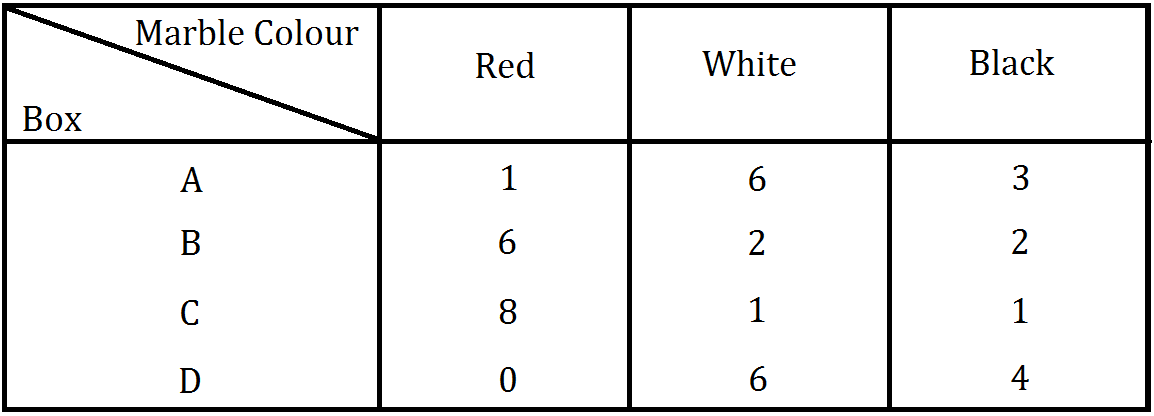
Suppose we have four boxes A, B, C, D containing coloured marbles as given below:
One of the boxes has been selected at random and a single marble is drawn from it. If the marble is red, what is the probability that it was drawn from,
  1. Box A?
  2. Box B?
  3. Box C?
A dietician wishes to mix together two kinds of food X and Y in such a way that the mixture contains at least 10 units of vitamin A, 12 units of vitamin B and 8 units of vitamin C. The vitamin contents of one kg food is given below:
Food
Vitamin A
Vitamin B
Vitamin C
X
1
2
3
Y
2
2
1
One kg of food X costs Rs. 16 and one kg of food Y costs Rs 20. Find the least cost of the mixture which will produce the required diet?
Solve $\cos^{-1}\sqrt3\text{x}+\cos^{-1}\text{x}=\frac{\pi}{2}$
A function $f : R \rightarrow R$ is defined as $f(x) = x^3 + 4.$ Is it a bijection or not? In case it is a bijection, find $f^{-1}(3).$
Find the points on the curve $x^2 + y^2 = 13$, the tangent at each one of which is parallel to the line $2x + 3y = 7.$
Prove the following :

$\tan ^{-1}\left(\frac{1}{2}\right)+\tan ^{-1}\left(\frac{1}{3}\right)=\frac{\pi}{4}$

Evaluate the following integral:
$\int\frac{1}{\sqrt{(2-\text{x})^2-1}}\text{ dx}$
The spaces described in time $t$ by a particle moving in a straight line is given by $s=t^5=4 t^3+30 t^2+80 t-250$. Find the minimum value of acceleration.
using interation, find the area of the region bounded by the triangle ragion, the euations of whose sides are$ y = 2x + 1, y = 3x + 1$ and $x = 4.$
Give examples of two surjective functions $f_1$ and $f_2$ from $Z$ to $Z$ such that $f_1 + f_2$ is not surjective.