MCQ
If a bimetallic strip is heated, it will
  • Bend towards the metal with lower linear thermal expansion coefficient
  • B
    Bend towards the metal with higher linear thermal expansion coefficient
  • C
    Not bend at all
  • D
    None

Answer

Correct option: A.
Bend towards the metal with lower linear thermal expansion coefficient
a
Bimetallic strip bends towards the metal with lower liner thermal expansion coefficient on heating.

Need a full question paper?

Generate a complete, print-ready paper with questions like this in minutes — across 16+ boards, with answer keys.

Start Generating Free

Similar questions

A block of mass $m$ is placed on a smooth horizontal surface. A force making an angle $\theta$ with the horizontal starts acting on the block. The magnitude of the force is constant but its direction with the horizontal changes as $\theta = a+ bs$, where $a$ and $b$ are constants and $s$ is the distance covered by the block. If $|F| = 2mb$, find the velocity of the block as function of the angle $\theta$ .
Given below are two statements. One is labelled as Assertion $A$ and the other is labelled as Reason $R$.

Assertion A :Two identical balls $A$ and $B$ thrown with same velocity '$u$ ' at two different angles with horizontal attained the same range $R$. If $A$ and $B$ reached the maximum height $h_{1}$ and $h_{2}$ respectively, then $R =4 \sqrt{ h _{1} h _{2}}$

Reason R: Product of said heights.

$h _{1} h _{2}=\left(\frac{u^{2} \sin ^{2} \theta}{2 g }\right) \cdot\left(\frac{u^{2} \cos ^{2} \theta}{2 g }\right)$

Choose the $CORRECT$ answer 
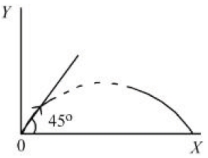
A particle of mass $100\,g$ is projected at time $t =0$ with a speed $20\,ms ^{-1}$ at an angle $45^{\circ}$ to the horizontal as given in the figure. The magnitude of the angular momentum of the particle about the starting point at time $t=2\,s$ is found to be $\sqrt{ K }\,kg\,m ^2 / s$. The value of $K$ is $............$ $\left(\right.$ Take $\left.g =10\,ms ^{-2}\right)$
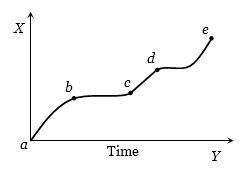
The displacement versus time graph for a body moving in a straight line is shown in figure. Which of the following regions represents the motion when no force is acting on the body
The increase in length is $l$ of a wire of length $L$ by the longitudinal stress. Then the stress is proportional to
A simple pendulum has time period 't'. Its time period in a lift which is moving upwards with acceleration $3 ms ^{-2}$ is
A particle moves in a plane along an elliptic path given by $\frac{x^2}{a^2}+\frac{y^2}{b^2}=1$. At point $(0, b)$, the $x$-component of velocity is $u$. The $y$-component of acceleration at this point is
Speed of sound waves in a fluid depends upon:
On sounding tuning fork $A$ with another tuning fork $B$ of frequency $384 Hz, 6$ beats are produced per second. After loading the prongs of $A$ with some wax and then sounding it again with $B, 4$ beats are produced per second. What is the frequency of the tuning fork $A$  .... $Hz$
A force of $5 \,N$ acts on a body of weight $9.8 \,N$. What is the acceleration produced in $m/{\sec ^2}$