MCQ
If a charged particle at rest experiences no electromagnetic force:
  • A
    The electric field must be zero.
  • B
    The magnetic field must be zero.
  • The electric field may or may not be zero.
  • D
    The magnetic field may or may not be zero.

Answer

Correct option: C.
The electric field may or may not be zero.
Force on charged particle in an electric eld, $\text{F} = \text{qE} \ ...(1)$
Force on charged particle in a magnetic eld $\text{F} = \text{q} (\text{v}\times\text{b}) = \text{qvB} \sin\theta \ ...(2) $
Where boldface letter represent vector nature of that quantity$, q$ is charge of the particle$, v$ is the velocity of the particle $($if any$),$ and $\theta$ is the angle between velocity and magnetic eld.
From $(1), F_E = 0$ only when either $q = 0$ or $E = 0.$
Let $q \neq 0,$ and $F \neq 0,$ then we must have $E \neq 0$
From $(2),$ if $q \neq 0, v \neq 0$ and $B \neq 0$ even then $F_B$ can be 'zero' because of $\theta = 0^\circ$ or $180^\circ$

Need a full question paper?

Generate a complete, print-ready paper with questions like this in minutes — across 16+ boards, with answer keys.
Start Generating Free

Similar questions

A hollow metallic sphere of radius $R$ is given a charge $Q$. Then the potential at the centre is 
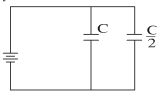
A capacitor of capacitance C and the other of capacitance $C / 2$ are connected to a battery of V volt as shown in the figure. The work done in charging both the capacitors fully is :
Image
The reactance of a circuit is zero. It is possible that the circuit contains:
The number of electrons to be put on a spherical conductor of radius $0.1m$ to produce an electric field of $0.036\ N/C$ just above its surface is
A double convex lens is made of glass of refractive index 1.5. If its focal length is 30 cm, then radius of curvature of each of its curved surface is(a) 10 cm (b) 15 cm(c) 18 cm (d) None of these
       
The idea of secondary wavelets for the propagation of a wave was first given by (a) Newton(b) Huygen(c) Maxwell(d) Fresnel
       
Electric room radiator which operates at 225 volts has resistance of 50 ohms. Power of the radiator is approximately(a) 100 W(b) 450 W(c) 750 W(d) 1000 W
       
Two identical lights sources $S_1$​ and $S_2$​ emit the light of same wavelength $\lambda$. These light rays will exhibit interference if:
Light takes $8$ min $20 \sec$ to reach from sun on the earth. If the whole atmosphere is filled with water, the light will take the time $\left(\mathrm{a}^{\mu_\omega}=4 / 3\right)$
X-rays which can penetrate through longer distances in substance are called (a) Soft X-rays(b) Continuous X-rays(c) Hard X-rays(d) None of the above