Question
If a constant force acts on a particle, its acceleration will:
  1. Remain constant.
  2. Gradually decrease.
  3. Gradually increase.
  4. Be undefined.

Answer

  1. Gradually decrease.
Explanation:
If a constant force is acting on a particle, the force will tend to accelerate the particle and increase its speed. But, due to increase in speed, the mass of the particle will increase by the relation $\text{m}=\frac{\text{m}_0}{\sqrt{1-\frac{\text{v}^2}{\text{c}^2}}}$
leading to decrease in acceleration as constant force is acting. Therefore, after sometime its acceleration will start decreasing gradually.

Need a full question paper?

Generate a complete, print-ready paper with questions like this in minutes — across 16+ boards, with answer keys.

Start Generating Free

Similar questions

Find the increase in pressure required to decrease the volume of a water sample by $0.01\%$. Bulk modulus of water $= 2.1 \times 10^9N/m^2.$
A vertical metal cylinder of radius $2\ cm$ and length $2\ m$ is fixed at the lower end and a load of $100\ kg$ is put on it. Find
  1. The stress.
  2. The strain and.
  3. The compression of the cylinder. Young's modulus of the metal $= 2 \times 10^{11} N/m^2.$
Write relation between magnetic induction B, magnetic field H and intensity of magnetisation I.
Which of the following methods can be used to measure the speed of light in water?
  1. Roemer method.
  2. Fizeau method.
  3. Focault method.
  4. Michelson method.
The power factor of an $a.c.$ circuit is $0.5.$ What is the phase difference between voltage and current in the circuit?
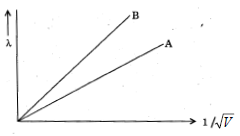
Two lines, A and B, in the plot given below show. the variation of de Broglie wavelength, $\lambda$ versus $1/\sqrt{\text{V}},$ where V is the accelerating potential difference, for two particles carrying the same charge. Which one of two represents a particle of smaller mass?
Write the names of nuclear chain reactions.
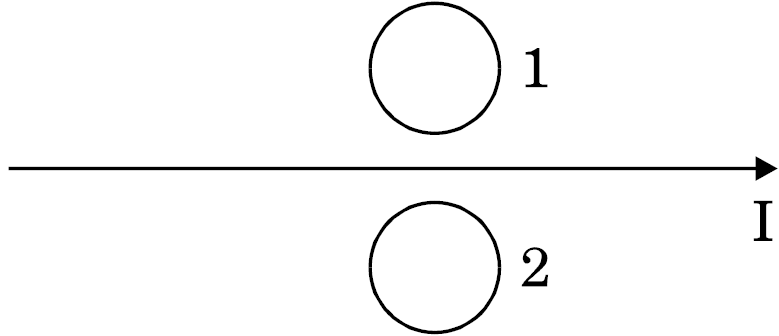
What is the direction of induced currents in metal rings 1 and 2 when current I in the wire is increasing steadily?
If the rate of change of current 2 ampere/ second induces an emf of 40 mV in the solenoid, what is the self-inductance of this solenoid?
Answer the following questions, which help you understand the difference between Thomson’s model and Rutherford’s model better.
Is the average angle of deflection of α-particles by a thin gold foil predicted by Thomson’s model much less, about the same, or much greater than that predicted by Rutherford’s model?