Question
If a constant potential difference is applied across a bulb, the current slightly decreases as time passes and then becomes constant. Explain.

Answer

As current passes through wire of bulb it heats up and thus the resistance of wire (element) increase as its metal so current decreases as resistance increases after element is heated well the resistance stops increasing thus current stops decreases.

Need a full question paper?

Generate a complete, print-ready paper with questions like this in minutes — across 16+ boards, with answer keys.
Start Generating Free

Similar questions

A wire of length 2.00m is stretched to a tension of 160N. If the fundamental frequency of vibration is 100Hz, find its linear mass density.
The yellow colour has a greater luminous efficiency as compared to the other colours. Can we increase the illuminating power of a white light source by putting a yellow plastic paper around this source?
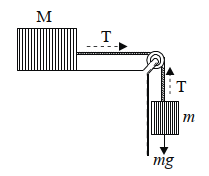
According to the figure, if the coefficient of static friction between block of mass 2 kg and the table is $\mu_s=0.2$ then what should be the maximum value of $m$ so that the block does not move while the pulley is light and frictionless.
Image
Keeping the angle of projection same, what is the effect on horizontal range of a particle when its velocity is doubled?
Give examples where:
  1. The velocity of a particle is zero but its acceleration is not zero.
  2. The velocity is opposite in direction to the acceleration.
  3. The velocity is perpendicular to the acceleration.
Does it matter if one uses gauge instead of absolute pressures in applying Bernoulli’s equation? Explain.
A boy is standing on a platform which is free to rotate about its axis. The boy holds an open umbrella in his hand. The axis of the umbrella coincides with that of the platform. The moment of inertia of ''the platform plus the boy system'' is $3.0 \times 10^{-3}kg-m^2$ and that of the umbrella is $2.0 \times 10^3kg-m^2$. The boy starts spinning the umbrella about the axis at an angular speed of $2.0rev/s$ with respect to himself. Find the angular velocity imparted to the platform.
Gas thermometers are more sensitive than mercury thermometers. Why?
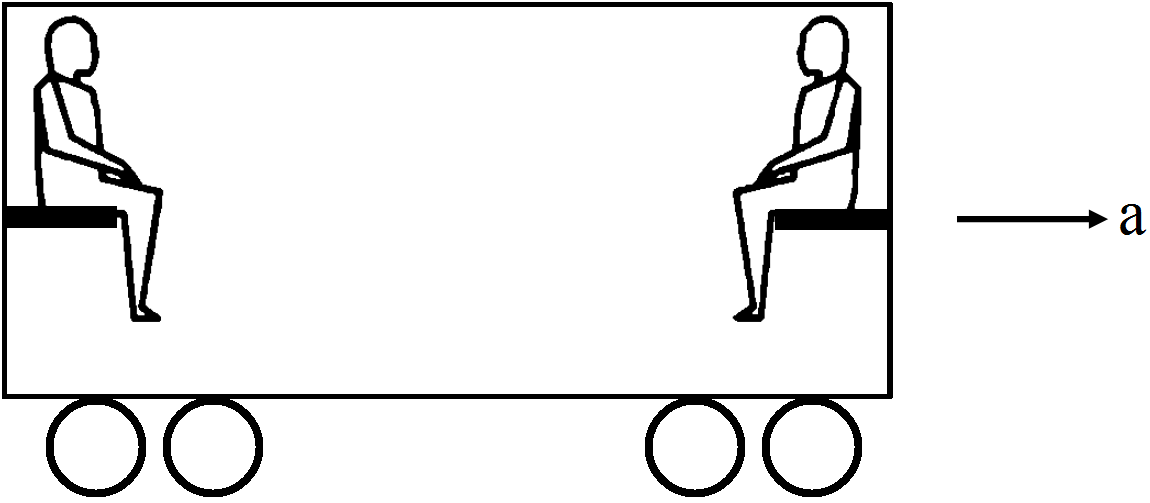
Which of the two persons shown in figure is more likely to fall down? Which external force is responsible for his falling down?
100%
Calculate the mass of $1cm^3$ of oxygen kept at STP.