Question
If a constant potential difference is applied across a bulb, the current slightly decreases as time passes and then becomes constant. Explain.

Answer

As current passes through wire of bulb it heats up and thus the resistance of wire (element) increase as its metal so current decreases as resistance increases after element is heated well the resistance stops increasing thus current stops decreases.

Need a full question paper?

Generate a complete, print-ready paper with questions like this in minutes — across 16+ boards, with answer keys.
Start Generating Free

Similar questions

Prove the Kepler's law, that the line joining the sun and the planet sweeps equal areas in equal time, using the angular momentum conservation with the planet. 
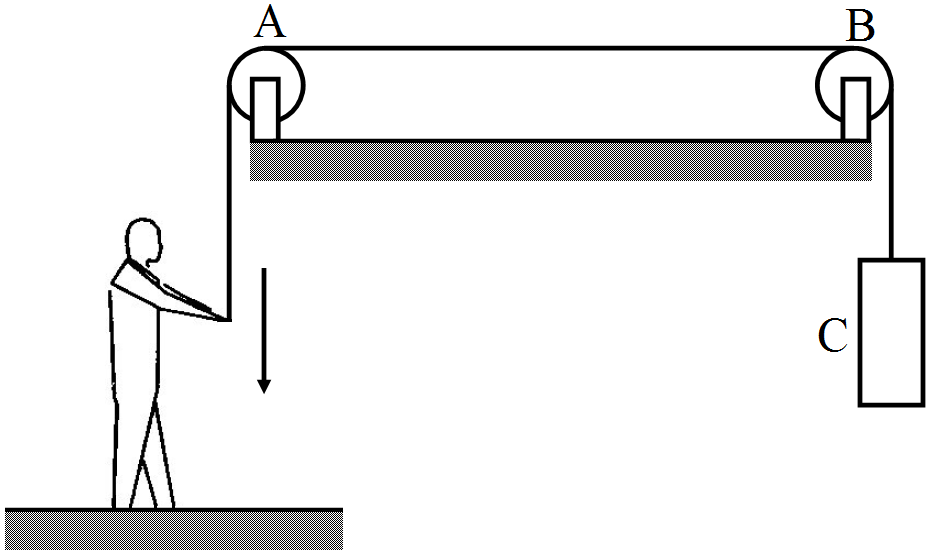
List all the forces acting on:
  1. The pulley A.
  2. The boy and.
  3. The block C in figure.

What happens to the change in internal energy of a gas during:
  1. Isothermal expansion?
  2. Adiabatic expansion?
A barometer tube is 80cm long (above the mercury reservoir). It reads 76cm on a particular day. A small amount of water is introduced in the tube and the reading drops to 75.4cm. Find the relative humidity in the space above the mercury column if the saturation vapour pressure at the room temperature is 1.0cm.
A voltmeter consists of a $25\Omega$ coil connected in series with a $575\Omega$ resistor. The coil takes 10mA for full scale deflection. What maximum potential difference can be measured by this voltmeter?
What are the limitations of the first law of thermodynamics?
A cyclist comes to a skidding stop in 10 m. During this process, the force on the cycle due to the road is 200 N and is directly opposed to the motion. (a) How much work does the road do on the cycle ? (b) How much work does the cycle do on the road ?
State the number of degrees of freedom possessed by a monoatomic molecule in space. Also give the expression for total energy possessed by it at a given temperature. Hence give the total energy of the atom at 300K.
A block of mass $m=1 kg$, moving on a horizontal surface with speed $V_l=2 m s ^{-1}$ enters a rough patch ranging from $x=0.10 m$ to $x=2.01 m$. The retarding force $F_r$ on the block in this range is inversely proportional to $x$ over this range,
$ F_r=\frac{-k}{x} \text { for } 0.1<x<2.01 m $ $=0$ for $x<0.1 m$ and $x>2.01 m$
where $k=0.5 J$. What is the final kinetic energy and speed $v_f$ of the block as it crosses this patch?
Two medium particles are separated by a distances $\frac{\lambda}{2}.$ What is the relationship between phase of these particles at any instant?