Question
If a constant potential difference is applied across a bulb, the current slightly decreases as time passes and then becomes constant. Explain.

Answer

As current passes through wire of bulb it heats up and thus the resistance of wire (element) increase as its metal so current decreases as resistance increases after element is heated well the resistance stops increasing thus current stops decreases.

Need a full question paper?

Generate a complete, print-ready paper with questions like this in minutes — across 16+ boards, with answer keys.
Start Generating Free

Similar questions

Three capacitors each of capacitance 9 pF are connected in series.
  1. What is the total capacitance of the combination?
  2. What is the potential difference across each capacitor if the combination is connected to a 120 V supply?
What is the resistance of an intrinsic semiconductor at 0K?
The force between two point charges kept at a distance r apart in air is F. If the same charges are kept in water at the same distance, how does the force between them change?
Given a uniform electric field$\overrightarrow{\text{E}}: 4 \times 10^3  \hat{i}$ N/C, find the flux of this field through a square of 5cm on a side whose plane is parallel to the y-z plane. What would be the flux through the same square if the plane makes a $30^{\circ}$ angle with the x-axis?
At what separation should two equal charges, 1.0C each, be placed so that the force between them equals the weight of a 50kg person?
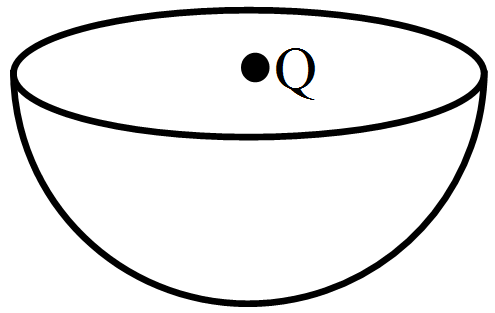
A charge Q is placed at the centre of an imaginary hemispherical surface. Using symmetry arguments and the Gauss's law, find the flux of the electric field due to this charge through the surface of the hemisphere (figure).
The current in a discharging LR circuit is given by $\text{i}=\text{i}_0\text{e}^{\frac{-\text{t}}{\tau}}$ where $\tau$ is the time constant of the circuit. Calculate the rms current for the period $\text{t}=0$ to $\text{t}=\tau.$
Is it possible for a particle to describe a curved path if no force acts on it? Does your answer depend on the frame of reference chosen to view the particle?
A block of mass 0.2kg is suspended from the ceiling by a light string. A second block of mass 0.3kg is suspended from the first block through another string. Find the tensions in the two strings. Take $g = 10m/s^2$.
Explain the refraction of a plane wave from rarer medium to a denser medium, using Huygen's principle.