MCQ
If $(a + ib)(c + id)(e + if)(g + ih)$$ = A + iB,$ then $({a^2} + {b^2})({c^2} + {d^2})({e^2} + {f^2})({g^2} + {h^2})$ =
  • ${A^2} + {B^2}$
  • B
    ${A^2} - {B^2}$
  • C
    ${A^2}$
  • D
    ${B^2}$

Answer

Correct option: A.
${A^2} + {B^2}$
a
(a)$(a + ib)(c + id)(e + if)(g + ih) = A + iB$.....$(i)$
==> $(a - ib)(c - id)(e - if)(g - ih) = A - iB$......$(ii)$
Multiplying $(i) $ and $(ii)$, we get
$({a^2} + {b^2})({c^2} + {d^2})({e^2} + {f^2})({g^2} + {h^2}) = {A^2} + {B^2}$
 

Need a full question paper?

Generate a complete, print-ready paper with questions like this in minutes — across 16+ boards, with answer keys.
Start Generating Free

Similar questions

The length of the tangent from the point $(4, 5)$ to the circle ${x^2} + {y^2} + 2x - 6y = 6$ is
If $\sin \beta $ is the geometric mean between $\sin \alpha $ and $\cos \alpha ,$ then $\cos 2\beta $ is equal to
The length of perpendicular drawn from origin on the line joining $(x',y')$ and $(x'',y'')$, is
The function $\mathrm{f}(\mathrm{x})$, that satisfies the condition $\mathrm{f}(\mathrm{x})=\mathrm{x}+\int_{0}^{\pi / 2} \sin \mathrm{x} \cdot \cos y \mathrm{f}(\mathrm{y}) \mathrm{dy}$, is :
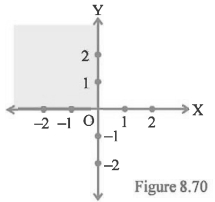
The coloured region in figure 8.70 is the solution set of $\ldots . . . .$
If $A$ lies in the second quadrant and $3\tan A + 4 = 0,$ the value of $2\cot A - 5\cos A + \sin A$ is equal to
The domain of definition of the function $f (x) = {\log _{\left[ {x + \frac{1}{x}} \right]}}|{x^2} - x - 6|+ ^{16-x}C_{2x-1} + ^{20-3x}P_{2x-5}$  is

Where $[x]$ denotes greatest integer function.

The condition that the straight line $lx + my = n$ may be a normal to the hyperbola ${b^2}{x^2} - {a^2}{y^2} = {a^2}{b^2}$ is given by
Consider the following lists:
$List-I$ $List-II$
$(I)\  \left\{x \in\left[-\frac{2 \pi}{3}, \frac{2 \pi}{3}\right]: \cos x+\sin x=1\right\}$ $(P)$ has two elements 
$(II)\  \left\{x \in\left[-\frac{5 \pi}{18}, \frac{5 \pi}{18}\right]: \sqrt{3} \tan 3 x=1\right\}$ $(Q)$ has three elements
$(III)\  \left\{x \in\left[-\frac{6 \pi}{5}, \frac{6 \pi}{5}\right]: 2 \cos (2 x)=\sqrt{3}\right\}$ $(R)$ has four elements
$(I)\  \left\{x \in\left[-\frac{6 \pi}{5}, \frac{6 \pi}{5}\right]: 2 \cos (2 x)=\sqrt{3}\right\}$ $(S)$ has five elements 
$(VI)\  \left\{x \in\left[-\frac{7 \pi}{4}, \frac{7 \pi}{4}\right]: \sin x-\cos x=1\right\}$ $(T)$ has six elements
The correct option is:
Distance of the point $(1, 2, 3)$ from the co-ordinate axes are