MCQ
If $A$  is a $n \times n$ matrix, then  $adj(adj \,A)$=
  • A
    $|A|{\,^{n - 1}}A$
  • $|A|{\,^{n - 2}}A$
  • C
    $|A{|^n}n$
  • D
    None of these

Answer

Correct option: B.
$|A|{\,^{n - 2}}A$
b
(b) We know by the fundamental concept that $adj\,(adj\,A) = |A{|^{n - 2}}A$.

Need a full question paper?

Generate a complete, print-ready paper with questions like this in minutes — across 16+ boards, with answer keys.

Start Generating Free

Similar questions

If $f\left( x \right) = {\left( {2x - 3\pi } \right)^5} + \frac{4}{3}x + \cos x$ and $g$ is the inverse of $f$, then $g'\left( {2\pi } \right)$  = ?
$\int\cos^{-1}(\frac{1}{\text{x}})\text{dx}$ equals:
  1. $\text{x}\sec^{-1}\text{x}+\log|\text{x}+\sqrt{\text{x}^2-1}|+\text{c}$
  2. $\text{x}\sec^{-1}\text{x}-\log|\text{x}+\sqrt{\text{x}^2-1}|+\text{c}$
  3. $-\text{x}\sec^{-1}\text{x}-\log|\text{x}+\sqrt{\text{x}^2-1}|+\text{c}$
  4. $\text{None of these}$
If the function $f(x)=\frac{\sin 3 x+\alpha \sin x-\beta \cos 3 x}{x^3}$, $x \in R$, is continuous at $x=0$, then $f(0)$ is equal to :
The function f(x) = [x], where [x] denotes the greatest integer function, is continuous at:
  1. 4
  2. -2
  3. 1
  4. 1.5
If $A = \left( {\begin{array}{*{20}{c}}1&2&3\\3&1&2\\2&3&1\end{array}} \right)$ and $B = \left( {\begin{array}{*{20}{c}}{ - 5}&7&1\\1&{ - 5}&7\\7&1&{ - 5}\end{array}} \right)$ then $AB$ is equal to
Consider $f(x) =$ $\left[ {\frac{{2\,\,\left( {\sin \,x\,\, - \,\,{{\sin }^3}\,x} \right)\,\, + \,\,\left| {\sin \,x\,\, - \,\,{{\sin }^3}\,x} \right|}}{{2\,\,\left( {\sin \,x\,\, - \,\,{{\sin }^3}\,x} \right)\,\, - \,\,\left| {\sin \,x\,\, - \,\,{{\sin }^3}\,x} \right|}}} \right]$ , $x \ne \,\frac{\pi}{2} \,for\, x \in (0, \pi ) f(\pi /2) = 3$

where [ ] denotes the greatest integer function then,
If $tan^{-1} (x^2 + 3|x|-4 )= tan^{-1} (4 \pi + sin^{-1}(sin14))$, then the value of $cos^{-1}(cos3|x|)$ is equal to
Assume $X,\, Y,\, Z, W$ and $P$ are the matrices of order $2 \times n, \,3 \times k,\, 2 \times p, \,n \times 3$ and $p \times k$ respectively. The restriction on $n,\, k$ and $p$ so that $P Y+W Y$ will be defined are :
If $a$ is perpendicular to $b$ and $c,|a| = 2,|b| = 3$, $|c| = 4$ and the angle between $b$ and $c$ is $\frac{{2\pi }}{3}$, then $[a\;b\;c]$ is equal to
Choose the correct answer from the given four options.

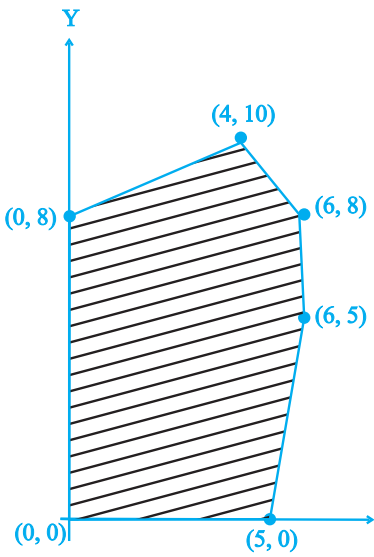
The feasible solution for a LPP shown in Fig. 12.12. Let z = 3x - 4y be objective functio. (Maximum value of Z + Minimum value of Z) is equal to:
  1. 13.
  2. 1.
  3. -13.
  4. -17.