Question
If A is a singular matrix, then adj A is:
  1. Non-singular.
  2. Singular.
  3. Symmetric.
  4. Not defined.

Answer

  1. Singular.

​​​​​​​Solution:

If A is singular matrix then adjoint of A is also singular.

Need a full question paper?

Generate a complete, print-ready paper with questions like this in minutes — across 16+ boards, with answer keys.
Start Generating Free

Similar questions

The optimal value of the objective function is attained at the points:
  1. On x - axis
  2. On y - axis
  3. Which are corner points of the feasible region
  4. None of these
$\Delta = \left| {\,\begin{array}{*{20}{c}}{a + x}&b&c\\b&{x + c}&a\\c&a&{x + b}\end{array}\,} \right|$,which of the following is a factor for the above determinant
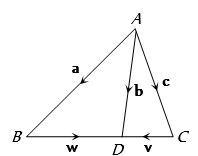
In the figure, a vector $x$  satisfies the equation $x - w = v$. Then $x =$
In a $\triangle\text{ABC},$ if C is a right angle, then

$\tan^{-1}\Big(\frac{\text{a}}{\text{b}+\text{c}}\Big)+\tan^{-1}\Big(\frac{\text{b}}{\text{c}+\text{b}}\Big)=$

  1. $\frac{\pi}{3}$

  2. $\frac{\pi}{4}$

  3. $\frac{5\pi}{2}$

  4. $\frac{\pi}{6}$

In order that the matrix $\left[ {\begin{array}{*{20}{c}}1&2&3\\4&5&6\\3&\lambda &5\end{array}} \right]$ be non-singular, $\lambda $ should not be equal to
The set of equations $x - y + 3z = 2 , 2x - y + z = 4 , x - 2y + \alpha z = 3$ has
Let f(x) = |x| and g(x) = |x3|, then:
  1. f(x) and g(x) both are continuous at x = 0
  2. f(x) and g(x) both are differentiable at x = 0
  3. f(x) is differentiable but g(x) is not differentiable at x = 0
  4. f(x) and g(x) both are not differentiable at x = 0
For a given matrix $A =$ $\left[ {\,\begin{array}{*{20}{c}}{\cos \theta }&{ - \,\sin \theta }\\{\sin \theta }&{\cos \theta }\end{array}\,} \right]$ which of the following statement holds good?
Let the value of $p = (x + 4y)\,a + (2x + y + 1)\,b$ and $q = (y - 2x + 2)\,a + (2x - 3y - 1)\,b,$ where $a $ and $b $ are non-collinear vectors. If $3p = 2q,$ then the value of $x $ and  $y$ will be
Let the solution $y=y(x)$ of the differential equation $\frac{d y}{d x}-y=1+4 \sin x$ satisfy $y(\pi)=1$. Then $y\left(\frac{\pi}{2}\right)+10$ is equal to...........................