Question
If $A$ is a square symmetric matrix, then $A ^{ T }=$_____

Answer

self

Need a full question paper?

Generate a complete, print-ready paper with questions like this in minutes — across 16+ boards, with answer keys.
Start Generating Free

Similar questions

If one pair of two unbiased dice are rolled, then probability of sum of number appear being 5 will be ___________ .
Fill in the blank.
The principal value of $\tan^{-1}\sqrt{3}$ is __________.
$f(x)=2 x$, for $f: N \rightarrow N$, is. ________ but not onto.
Fill in the blank.
The negative of a matrix is obtained by multiplying it by _________.
Fill in the blanks.
A plane passes through the points (2, 0, 0) (0, 3, 0) and (0, 0, 4). The equation of plane is __________.
If E and F are independent events then $P ( E \cap F )=$ ___________ .
Fill in the blanks.
The vectors $\vec{\text{a}}=3\hat{\text{i}}-2\hat{\text{j}}+2\hat{\text{k}}$ and $\vec{\text{b}}=-\hat{\text{i}}-2\hat{\text{k}}$ are the adjacent sides of a parallelogram. The angle between its diagonals is _________.
Fill in the blank.
The product of any matrix by the scalar _________ is the null matrix.
If A has skew symmetric matrix having order $3 \times 3$, $|A|=$ __________ .
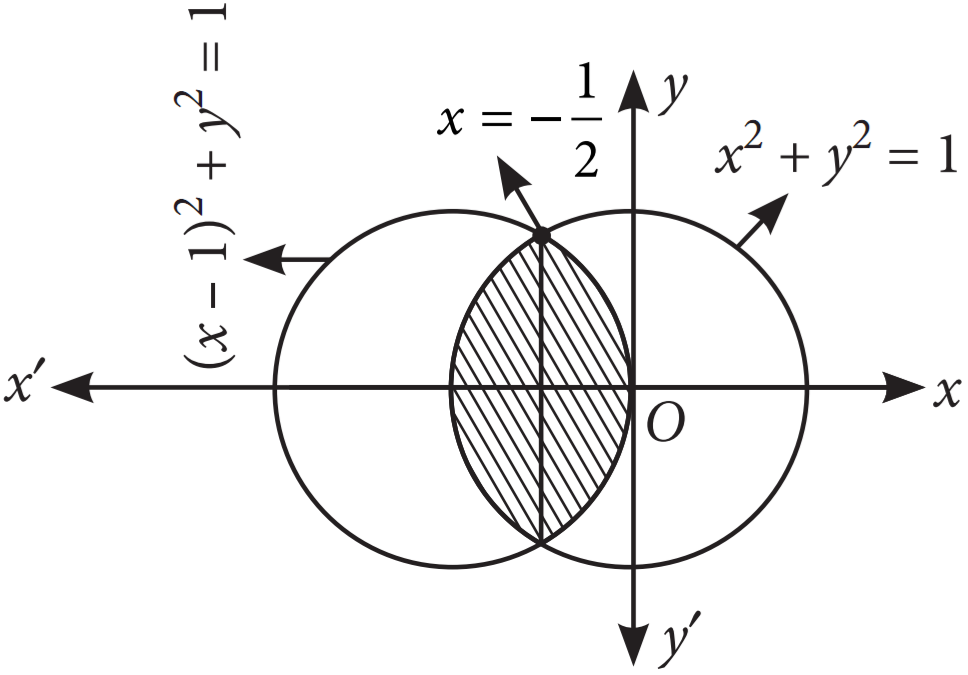
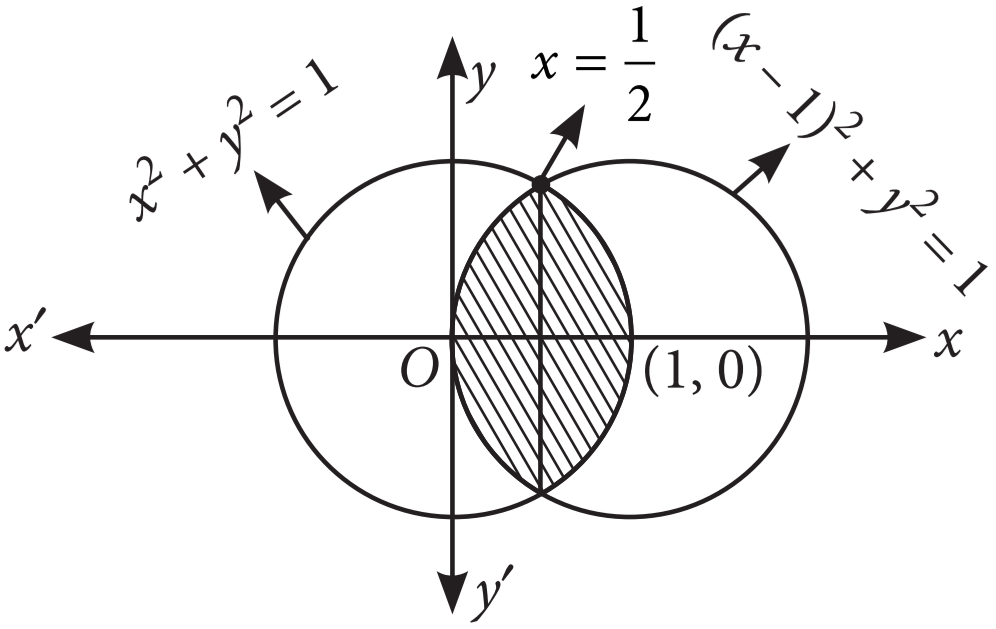
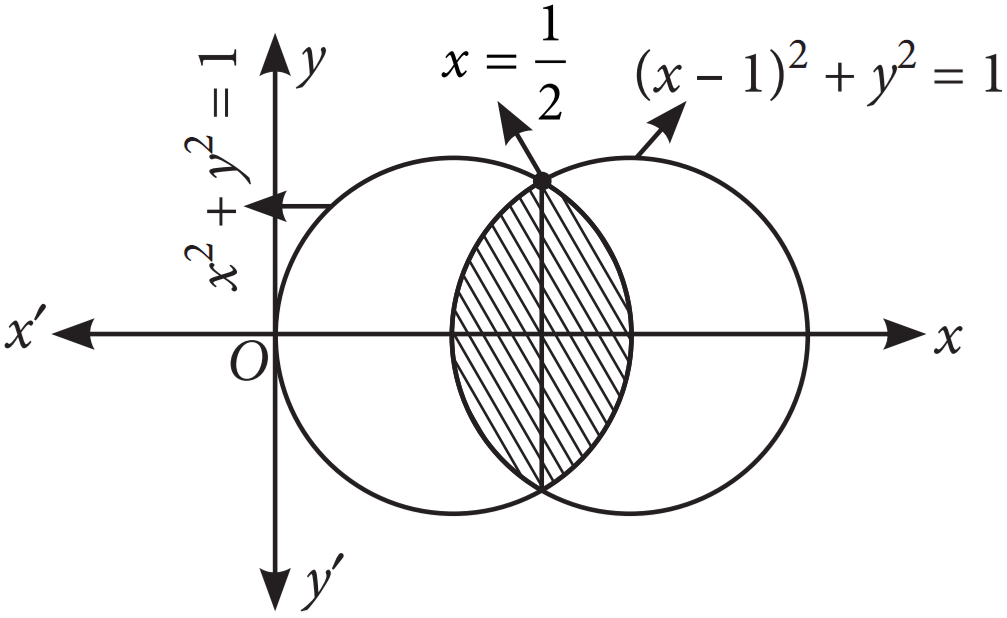
Ajay cut two circular pieces of cardboard and placed one upon other as shown in figure. One of the circle represents the equation $(x - 1)^2+ y^2= 1$, while other circle represents the equation $x^2+ y^2= 1.$

Based on the above information, answer the following questions.
  1. Both the circular pieces of cardboard meet each other at
  1. $\text{x}=1$
  2. $\text{x}=\frac{1}{2}$
  3. $\text{x}=\frac{1}{3}$
  4. $\text{x}=\frac{1}{4}$
  1. Graph of given two curves can be drawn as.
  1. None of these
  1. Value of $\int\limits_{0}^{\frac{1}{2}}\sqrt{1-(\text{x}-1)^2}\text{dx}$ is.
  1. $\frac{\pi}{6}-\frac{\sqrt{3}}{8}$
  2. $\frac{\pi}{6}+\frac{\sqrt{3}}{8}$
  3. $\frac{\pi}{2}+\frac{\sqrt{3}}{4}$
  4. $\frac{\pi}{2}-\frac{\sqrt{3}}{4}$
  1. Value of $\int\limits_{\frac{1}{2}}^{1}\sqrt{1-\text{x}^2}\text{dx}$ is.
  1. $\frac{\pi}{6}+\frac{\sqrt{3}}{4}$
  2. $\frac{\pi}{6}+\frac{\sqrt{3}}{8}$
  3. $\frac{\pi}{6}-\frac{\sqrt{3}}{8}$
  4. $\frac{\pi}{2}-\frac{\sqrt{3}}{4}$
  1. Area of hidden portion of lower circle is.
  1. $\bigg(\frac{2\pi}{3}+\frac{\sqrt{3}}{2}\bigg)\text{ sq.units}$
  2. $\bigg(\frac{\pi}{3}-\frac{\sqrt{3}}{8}\bigg)\text{ sq.units}$
  3. $\bigg(\frac{\pi}{3}+\frac{\sqrt{3}}{8}\bigg)\text{ sq.units}$
  4. $\bigg(\frac{2\pi}{3}-\frac{\sqrt{3}}{2}\bigg)\text{ sq.units}$