MCQ
If $A = \left[ {\begin{array}{*{20}{c}}
3&7\\
1&2
\end{array}} \right]$ then $|A^{2011} -5A^{2010}|$ is equal to
  • A
    $1$
  • $-1$
  • C
    $6$
  • D
    $-6$

Answer

Correct option: B.
$-1$
b
$\left|\mathrm{A}^{2011}-5 \mathrm{A}^{2010}\right|=|\mathrm{A}|^{2010}|\mathrm{A}-5 \mathrm{I}|$

$A-5 I=\left(\begin{array}{ll}{3} & {7} \\ {1} & {2}\end{array}\right)-\left(\begin{array}{ll}{5} & {0} \\ {0} & {5}\end{array}\right)=\left(\begin{array}{cc}{-2} & {7} \\ {1} & {-3}\end{array}\right)$

$|A-5 I|=-1$ and $|A|=-1$

So $|\mathrm{A}|^{2010}|\mathrm{A}-5 \mathrm{I}|=(-1)^{2010}(-1)=-1$

Need a full question paper?

Generate a complete, print-ready paper with questions like this in minutes — across 16+ boards, with answer keys.

Start Generating Free

Similar questions

Let $f :[2,4] \rightarrow R$ be a differentiable function such that $\left(x \log _e x\right) f^{\prime}(x)+\left(\log _e x\right) f(x)+f(x) \geq 1$, $x \in[2,4]$ with $f(2)=\frac{1}{2}$ and $f(4)=\frac{1}{4}$.

Consider the following two statements:

$(A): f(x) \leq 1$, for all $x \in[2,4]$

$(B)$ : $f(x) \geq \frac{1}{8}$, for all $x \in[2,4]$

Then,
If $f(x) = \left\{ \begin{array}{l}{x^2}\sin \frac{1}{x},\;\;\;{\rm{when\,\, }}x \ne 0\\\,\,\,\,\,\,\,\,\,\,\,\,\,\,0,\,\,\,\,{\rm{when\,\,}}\,x = 0\end{array} \right.$, then
The vectors $2\hat{\text{i}}+3\hat{\text{j}}-4\hat{\text{k}}$ and $\text{a}\hat{\text{i}}+\text{b}\hat{\text{j}}+\text{c}\hat{\text{k}}$ are perpendicular if :
The maximum value of $\text{f}(\text{x})=\frac{\text{x}}{4-\text{x}+\text{x}^{2}}$ on $[-1, 1]$ is :
$\int\limits_0^\infty  {} x^{2n + 1}·{e^{ - {x^2}}}\, dx$ is equal to $(n \in N).$
Let $C_{1}$ be the curve obtained by the solution of differential equation $2 xy \frac{ dy }{ dx }= y ^{2}- x ^{2}, x > 0$ Let the curve $C _{2}$ be the solution of $\frac{2 x y}{x^{2}-y^{2}}=\frac{d y}{d x} .$ If both the curves pass through $(1,1),$ then the area enclosed by the curves $C_{1}$ and $C _{2}$ is equal to :
The value of $\int_{\, - 2}^{\,2} {\left[ {p\ln \left( {\frac{{1 + x}}{{1 - x}}} \right) + q\ln {{\left( {\frac{{1 - x}}{{1 + x}}} \right)}^{ - 2}} + r} \right]\,dx} $ depends on
$\int_0^{\pi /4} {\log (1 + \tan \theta )\,d\theta = } $
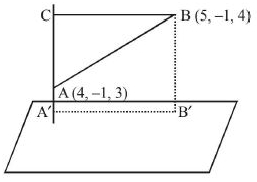
The length of the projection of the line segment joining the point  $\left( {5, - 1,4} \right)$ and $\left( {4, - 1,3} \right)$ on the plane $x + y + z = 7$ is :
If $\text{y}=\frac{2}{\sqrt{\text{a}^2-\text{b}^2}}\tan^{-1}\Big(\frac{\text{a}-\text{b}}{\text{a}+\text{b}}\tan\frac{\text{x}}{2}\Big),\text{a} > \text{b}>0,$ then :