MCQ
If $A = \left[ {\begin{array}{*{20}{c}}1&0\\1&1\end{array}} \right]$ and $I = \left[ {\begin{array}{*{20}{c}}1&0\\0&1\end{array}} \right]$, then which one of the following holds for all $n \ge 1$, (by the principal of mathematical induction)
  • A
    ${A^n} = nA + (n - 1)I$
  • B
    ${A^n} = {2^{n - 1}}A + (n - 1)I$
  • ${A^n} = nA - (n - 1)I$
  • D
    ${A^n} = {2^{n - 1}}A - (n - 1)I$

Answer

Correct option: C.
${A^n} = nA - (n - 1)I$
c
(c) ${A^2} = \left[ {\begin{array}{*{20}{c}}1&0\\1&1\end{array}} \right]\,\left[ {\begin{array}{*{20}{c}}1&0\\1&1\end{array}} \right] = \left[ {\begin{array}{*{20}{c}}1&0\\2&1\end{array}} \right]$

${A^3} = \left[ {\begin{array}{*{20}{c}}1&0\\2&1\end{array}} \right]\,\left[ {\begin{array}{*{20}{c}}1&0\\1&1\end{array}} \right] = \left[ {\begin{array}{*{20}{c}}1&0\\3&1\end{array}} \right]$

$\therefore $ ${A^n} = \left[ {\begin{array}{*{20}{c}}1&0\\n&1\end{array}} \right]$ $;$ $nA = \left[ {\begin{array}{*{20}{c}}n&0\\n&n\end{array}} \right],(n - 1)I = \left[ {\begin{array}{*{20}{c}}{n - 1}&0\\0&{n - 1}\end{array}} \right]$

$nA - (n - 1)I = \left[ {\begin{array}{*{20}{c}}1&0\\n&1\end{array}} \right] = {A^n}$.

Need a full question paper?

Generate a complete, print-ready paper with questions like this in minutes — across 16+ boards, with answer keys.

Start Generating Free

Similar questions

If a line makes 45°, 60° with positive direction of axes x and y then the angles it makes with the z-axis is:
Let R be the relation in the set N given by R = {(a, b) : a = b – 2, b > 6}. Choose
the correct answer.
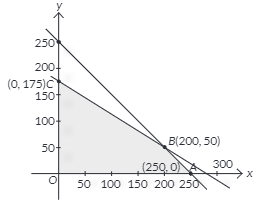
The corner points of the bounded feasible region of an LPP are $O(0,0), A(250,0), B(200,50)$ and $C(0,175)$. If the maximum value of the objective function $Z=2 a x+$ by occurs at the points $A(250,0)$ and $B(200,50)$, then the relation between $a$ and $b$ is:
Image
A box contains 3 orange balls, 3 green balls and 2 blue balls. Three balls are drawn at random from the box without replacement. The probability of drawing 22 green balls and one blue ball is
If a line makes angles $Q_1, Q_{21}$ and $Q_3$ respectively with the coordinate axis then the value of $\cos^2 \text{Q}_{1} + \cos^2 \text{Q}_{2} + \cos^2 \text{Q}_{3}:$
For a differentiable function $\mathrm{f}: I R \rightarrow I R$, suppose $f^{\prime}(\mathrm{x})=3 f(\mathrm{x})+\alpha$, where $\alpha \in \operatorname{IR}, f(0)=1$ and $\lim _{x \rightarrow-\infty} f(x)=7$. Then $9 \mathrm{f}\left(-\log _{\mathrm{e}} 3\right)$ is equal to ............
If A and B are two events associated to a random experiment such that $\text{P}(\text{A}\cap\text{B})=\frac{7}{10}$ and $\text{P(B)}=\frac{17}{20}$, then P(A|B) =
Let $x, y, z > 0$ are respectively $2^{nd}, 3^{rd}, 4^{th}$ term of $G.P.$ and $\Delta  = \left| {\begin{array}{*{20}{c}}
{{X^k}}&{{X^{k + 1}}}&{{X^{k + 2}}}\\
{{Y^k}}&{{Y^{k + 1}}}&{{Y^{k + 2}}}\\
{{Z^k}}&{{Z^{k + 1}}}&{{Z^{k + 2}}}
\end{array}} \right| = {\left( {r - 1} \right)^2}\left( {1 - \frac{1}{{{r^2}}}} \right)$ , (where $r$ is common ratio), then $k=$ .......
Let $f(x) = sin\ x, g(x) = cos\ x$ , then which of the following statement is false
The foot of perpendicular from the origin $O$ to a plane $P$ which meets the co-ordinate axes at the points $A, B, C$ is $(2, a, 4), a \in N$. If the volume of the tetrahedron $OABC$ is $144$ unit $^3$, then which of the following points is $NOT$ on $P$ ?