Question
If $A =\left[\begin{array}{cc}1 & 2 \\ -2 & 3\end{array}\right], B =\left[\begin{array}{ll}2 & 1 \\ 2 & 3\end{array}\right] C =\left[\begin{array}{cc}-3 & 1 \\ 2 & 0\end{array}\right]$ verify that $(AB)C = A(BC),$

Answer

$A B=\left[\begin{array}{cc}1 & 2 \\ -2 & 3\end{array}\right]\left[\begin{array}{ll}2 & 1 \\ 2 & 3\end{array}\right] $
$ =\left[\begin{array}{cc}2+4 & 1+6 \\ -4+6 & -2+9\end{array}\right]=\left[\begin{array}{ll}6 & 7 \\ 2 & 7\end{array}\right]$
$( AB ) C =\left[\begin{array}{ll}6 & 7 \\ 2 & 7\end{array}\right]\left[\begin{array}{cc}-3 & 1 \\ 2 & 0\end{array}\right] $
$=\left[\begin{array}{cc}-18+14 & 6+0 \\ -6+14 & 2+0\end{array}\right]=\left[\begin{array}{cc}-4 & 6 \\ 8 & 2\end{array}\right] $
Now $,  BC =\left[\begin{array}{ll}2 & 1 \\ 2 & 3\end{array}\right]\left[\begin{array}{cc}-3 & 1 \\ 2 & 0\end{array}\right] $
$ =\left[\begin{array}{cc}-6+2 & 2+0 \\ -6+6 & 2+0\end{array}\right]=\left[\begin{array}{cc}-4 & 2 \\ 0 & 2\end{array}\right]$
$ A(B C)=\left[\begin{array}{cc} 1 & 2 \\ -2 & 3 \end{array}\right]\left[\begin{array}{cc} -4 & 2 \\
0 & 2 \end{array}\right] $
$=\left[\begin{array}{cc} -4+0 & 2+4 \\ 8+0 & -4+6  \end{array}\right]=\left[\begin{array}{cc} -4 & 6 \\ 8 & 2
\end{array}\right]$
Hence, $(A B) C=A(B C)$.

Need a full question paper?

Generate a complete, print-ready paper with questions like this in minutes — across 16+ boards, with answer keys.

Start Generating Free

Similar questions

Find $x$ from the following equations $: \frac{3 x+\sqrt{9 x^2-5}}{3 x-\sqrt{9 x^2-5}}=\frac{5}{1}$
Find three numbers in A.P whose sum is $24$ and whoseproduct is $440$
Marks obtained by 200 students in an examination are given below: 
Marks No.of students
0-10 5
10-20 11
20-30 10
30-40 20
40-50 28
50-60 37
60-70 40
70-80 29
80-90 14
90-100 6
Draw an ogive for the given distribution taking 2 cm = 10 marks on one axis and 2 cm = 20 students on the other axis. Using the graph, determine
1)The median marks.
2)The number of students who failed if minimum marks required to pass is 40.
3)If scoring 85 and more marks are considered as grade one, find the number of students who secured grade one in the examination.
A cubical block of side $7$ cm is surmounted by a hemisphere of the largest size. Find the surfacearea of the resulting solid.
A man buys 75, Rs 100 shares of a company which pays 9 per cent dividend. He buys shares at such a price that he gets 12 per cent of his money. At what price did he buy the shares?
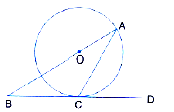
The given figure shows a circle with centre O and BCD is tangent to it at C. Show that: ∠ACD + ∠BAC = 90°
If $A=\left[\begin{array}{ll}2 & 3 \\ 5 & 7\end{array}\right], B=\left[\begin{array}{cc}0 & 4 \\ -1 & 7\end{array}\right]$ and $C=\left[\begin{array}{cc}1 & 0 \\ -1 & 4\end{array}\right]$, find $A C+B^2-10 C$.
Solve the quadratic equation $x^2 - 3(x + 3) = 0$; Give your answer correct two significant figures
A hollow metallic cylindrical tube has an internal radius of 3.5 cm and height 21 cm. The thickness of the metal tube is 0.5 cm. The tube is melted and cast into a right circular cone of height 7 cm. Find the radius of the cone, correct to one decimal place. 
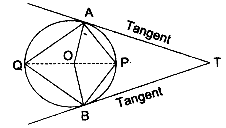
In the adjoining diagram TA and TB are tangents, O is the centre. If ∠ PAT = 35° and ∠ PBT = 40°.
Calculate:
(i) ∠ AQP, (ii) ∠ BQP
(iii) ∠ AQB, (iv) ∠ APB
(v) ∠ AOB, (vi) ∠ ATB