MCQ
If a proton and electron have same de Broglie wavelength, then:
  • A
    Kinetic energy of electron < kinetic energy of proton
  • B
    Kinetic energy of electron = kinetic energy of proton
  • C
    Momentum of electron = momentum of proton
  • D
    Momentum of electron < momentum of proton

Answer

  1. Momentum of electron = momentum of proton

Explanation:

If proton and electron have same debroglie wavelength then momentum of electron is equals to momentum of proton.

Need a full question paper?

Generate a complete, print-ready paper with questions like this in minutes — across 16+ boards, with answer keys.

Start Generating Free

Similar questions

A small lamp is hung at a height of 8 feet above the centre of a round table of diameter 16 feet. The ratio of intensities of illumination at the centre and at points on the circumference of the table will be

(a) 1 : 1

(b) 2 : 1

(c) 2 

(d) 3 : 2

The decay constant of radium is 4.28  per year. Its half life will be

(a) 2000 years

(b) 1240 years

(c) 63 years

(d) 1620 years

A substance is behaving as convex lens in air and concave in water, then its refractive index is

(a) Smaller than air

(b) Greater than both air and water

(c) Greater than air but less than water

(d) Almost equal to water

Among the following properties describing diamagnetism identify  the property that is wrongly stated

(a) Diamagnetic material do not have permanent magnetic moment

(b) Diamagnetism is explained in terms of electromagnetic induction

(c) Diamagnetic materials have a small positive susceptibility

(d) The magnetic moment of individual electrons neutralize each other

According to Coulomb’s law, the coulomb force measured between two point charges is directly proportional to:

Wavelength of a 1 keV photon is . What is the frequency of 1 MeV photon

(a) 1.24  

(b) 2.4 

(c) 1.24   

(d) 2.4   

A potentiometer wire has length 10 m and resistance 20Ω. A 2.5 V battery of negligible internal resistance is connected across the wire with an 80 Ω series resistance. The potential gradient on the wire will be

(a) 5  

(b) 2.5  

(c) 0.62  

(d) 1 

The magnifying power of a telescope is $M$. If the focal length of the eye lens is doubled, then the magnifying power will be :
Unit of relative permeability is:

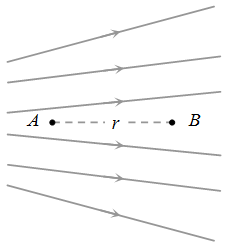
Figure shows the electric lines of force emerging from a charged body. If the electric field at A and B are   and   respectively and if the displacement between A and B is r then

(a)  

(b)  

(c)  

(d)