MCQ
If a proton and electron have same de Broglie wavelength, then:
  • A
    Kinetic energy of electron $<$ kinetic energy of proton
  • B
    Kinetic energy of electron $=$ kinetic energy of proton
  • Momentum of electron $=$ momentum of proton
  • D
    Momentum of electron $<$ momentum of proton
Answer

Correct option: C.
Momentum of electron $=$ momentum of proton

If proton and electron have same debroglie wavelength then momentum of electron is equals to momentum of proton.

Need a full question paper?

Generate a complete, print-ready paper with questions like this in minutes — across 16+ boards, with answer keys.

Start Generating Free

Similar questions

$........$ Charge is produced by friction
A parallel combination of two resistors, of $1  \,\Omega$ each, is connected in series with a $1.5  \,\Omega$ resistor. The total combination is connected across a $10\, V$ battery. The current flowing in the circuit is .............. $A$
The half life of a radioactive substance against $\alpha  - $ decay is $1.2 \times 10^7\, s$. What is the decay rate for $4.0 \times 10^{15}$ atoms of the substance
An electric field $\overrightarrow{\text{E}}$ and a magnetic field $\overrightarrow{\text{B}}$ exist in a region. The fields are not perpendicular to each other.
The de-Broglie wavelength associated with the electron in the $n\, = 4$ level is
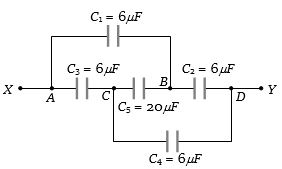
What is the effective capacitance between points $X$ and $Y$.......$\mu F$
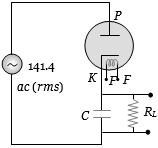
An alternating voltage of $141.4\,V$ (rms) is applied to a vacuum diode as shown in the figure. The maximum potential difference across the condenser will be......$V$
A circular loop of radius $0.3\, cm$ lies parallel to a much bigger circular loop of radius $20 \,cm$. The centre of the small loop on the axis of the bigger loop. The distance between their centres is $15\, cm$. If a current of $20\, A$ flows through the smaller loop, then the flux linked with bigger loop is
We are able to obtain fairly large currents in a conductor because
Two charged particles of masses $m$ and $2m$ have charges $+2q$ and $+q$ respectively. They are kept in uniform electric field and allowed to move for some time. The ratio of their kinetic energies will be