Question
If a refrigerator’s door is kept open, will the room become cool or hot? Explain.

Answer

If a refrigerator door is kept open the room will become hotter, because amount of heat absorbed from inside the refrigerator and work done on refrigerator by electricity both will be rejected by refrigerator in room.

Need a full question paper?

Generate a complete, print-ready paper with questions like this in minutes — across 16+ boards, with answer keys.
Start Generating Free

Similar questions

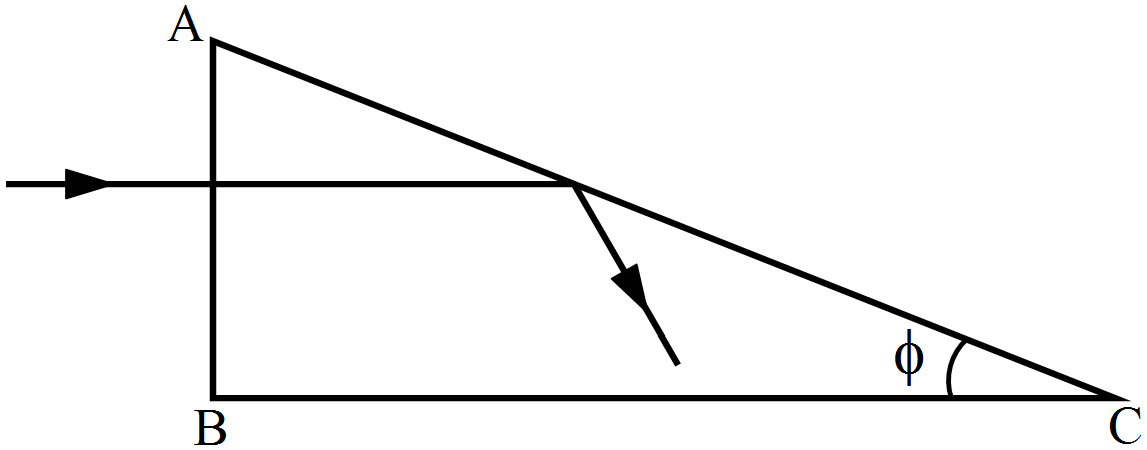
 A light ray is incident normally on the face AB of a right-angled prism ABC $(\mu=1.50)$ as shown in figure. What is the largest angle $\phi$ for which the light ray is totally reflected at the surface AC? 

If $n _0=2.79 \times 10^{25}$ molecules $m ^{-3}$ and mean free path $=2.2 \times 10^{-8} m$ then estimate the diameter of the molecules.
A monkey is sitting on a tree limb. The limb exerts a normal force of 48N and a frictional force of 20N. Find the magnitude of the total force exerted by the limb on the monkey.
Disc of mass $M$ and radius $R$ are fixed on the edges of a massless rod of length $2 R$. Find the moment of inertia of this system perpendicular to the rod and relative to the axis passing through its center.
A, B and C are three non-collinear, non co-planar vectors. What can you say about direction of A × (B × C)?
An ideal Carnot engine uses an ideal gas. The source temperature is 500 K and the arrival temperature is 375 K . If the engine takes 500 K cal from the source per cycle then estimate (a) efficiency of engine (b) work done per cycle (c) per heat dissipated in bicycle access.
A steel rod of length 1m rests on a smooth horizontal base. If it is heated from 0°C to 100°C, what is the longitudinal strain developed?
The temperatures of the junctions of a bismuth-silver thermocouple are maintained at 0°C and 0.001°C. Find the thermo-emf (Seebeck emf) developed. For bismuth-silver, a = -46 × 10-6V°C-1 and b = -0.48 × 10⁻⁶V°C-2.
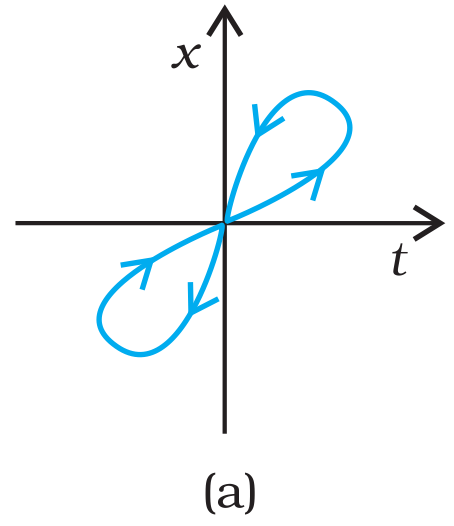
Look at the graphs carefully and state, with reasons, which of these cannot possibly represent one-dimensional motion of a particle.

A cyclist speeding at 18km/ h on a level road takes a sharp circular turn of radius 3m without reducing the speed. The co-efficient of static friction between the tyres and road is 0.1. Will the cyclist slip while taking the turn? Explain.