Question
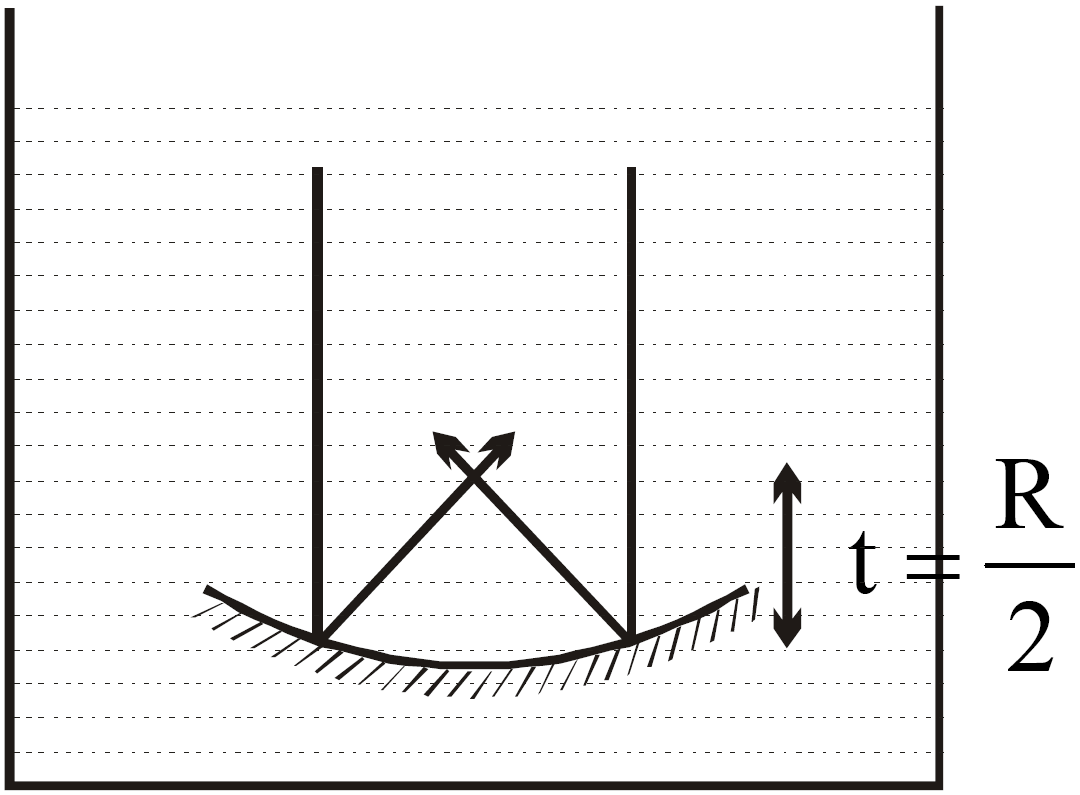
If a spherical mirror is dipped in water, does its focal length change?

Answer

No (offcourse we always take the thickness of mirror to be 3 to 4mm only)

If thickness of mirror is there then refraction through glass and water is to be considered.

Need a full question paper?

Generate a complete, print-ready paper with questions like this in minutes — across 16+ boards, with answer keys.
Start Generating Free

Similar questions

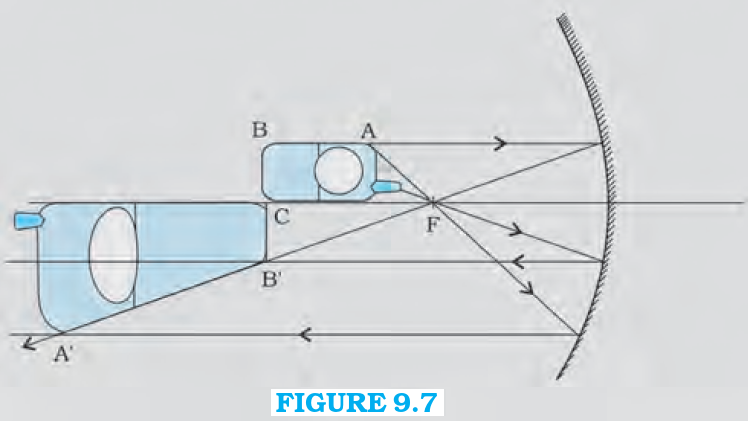
A mobile phone lies along the principal axis of a concave mirror, as shown in Fig. 9.7. Show by suitable diagram, the formation of its image. Explain why the magnification is not uniform. Will the distortion of image depend on the location of the phone with respect to the mirror?
Image
The threshold wavelength of a metal is $\lambda_0.$ Light of wavelength slightly less $\tan \lambda_0.$ is incident on an insulated plate made of this metal. It is found that photoelectrons are emitted for some time and after that the emission stops. Explain.
Is a vector necessarily changed if it is rotated through an angle?
Do electrons try to move to a higher potential region or a lower potential region, why?
Which of the statements is true for p-type semiconductos.
  1. Electrons are majority carriers and trivalent atoms are the dopants.
  2. Electrons are minority carriers and pentavalent atoms are the dopants.
  3. Holes are minority carriers and pentavalent atoms are the dopants.
  4. Holes are majority carriers and trivalent atoms are the dopants.
Would you prefer a voltmeter or a potentiometer to measure the emf of a battery?
Light passes through a closed cylindrical tube containing a gas. If the gas is gradually pumped out, the speed of light inside the tube will:
  1. Increase.
  2. Decrease.
  3. Remain constant.
  4. First increase and then decrease.
A sample of $\ce{HCl}$ gas is placed in an electric field of $3 \times 10^4 N / C$. The dipole moment of each molecule of $\ce{HCl}$ is $6 \times 10^{-30} C \times m$. What will be the maximum torque acting on the molecule?
Write the mathematical form of Ampere-Maxwell circuital law.
When the frequency of the AC source in an LCR circuit equals the resonant frequency, the reactance of the circuit is zero. Does it mean that there is no current through the inductor or the capacitor?