MCQ
If $\overrightarrow A \times \overrightarrow B=\overrightarrow B \times \overrightarrow A$ then the angle between $\overrightarrow A$ and $\overrightarrow B$ is
  • A
    $\pi / 2$
  • B
    $\pi / 3$
  • $\pi$
  • D
    $\pi / 4$

Answer

Correct option: C.
$\pi$
c
(c) We know that $\overrightarrow A \times \overrightarrow B = - (\overrightarrow B \times \overrightarrow A )$ because the angle between these two is always $90^°$.

But if the angle between $\overrightarrow A $ and $\overrightarrow B $ is $0^°$. Then $\overrightarrow A \times \overrightarrow B = \overrightarrow B \times \overrightarrow A = 0$.

Need a full question paper?

Generate a complete, print-ready paper with questions like this in minutes — across 16+ boards, with answer keys.
Start Generating Free

Similar questions

The position of a particle moving in the $xy-$ plane at any time $t$ is given by $x = (3t^2 -6t)\, metres$, $y = (t^2 -2t)\,metres$. Select the correct statement about the moving particle from the following
Specific heat capacity depends on:
A block of mass $1 \,kg$ slides down on a rough inclined plane of inclination $60^°$ starting from its top. If the coefficient of kinetic friction is $0.5$ and length of the plane is $1 \,m$, then work done against friction is ........ $J$
A wave in a string has an amplitude of $2\,\, cm.$ The wave travels in the $+ve$ direction of $x-$ axis with a speed of $128\,\, m/s$ and it is noted that $5$ complete waves fit in $4\,\, m$ length of the string. The equation describing the wave is
A bomb is released from a horizontal flying aeroplane. The trajectory of bomb is
A liquid is kept in a cylindrical vessel. When the vessel is rotated about its axis, the liquid rises at its sides. If the radius of the vessel is $0.05\,\, m$ and the speed of rotation is $2$ revolutions per second, the difference in the heights of the liquid at the centre and at the sides of the vessels will be ...... $cm.$ $($ take $g = 10\,\, ms^{-2}$ and $\pi^2 = 10)$
The dimensional formula $[ML^0T^{-3}]$ is more closely associated with
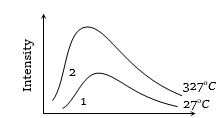
The spectrum of a black body at two temperatures $27^oC$ and $327^oC$ is shown in the figure. Let $A_1$ and $A_2$ be the areas under the two curves respectively. The value of $\frac{{{A_2}}}{{{A_1}}}$ is
A solid cylinder of mass $M$ and radius $R$ rolls down an inclined plane without slipping. The speed of its centre of mass when it reaches the bottom is ...
Which of the following states of matter has the maximum value of mean free path?