MCQ
If $AB = A$ and $BA = B,$ where $A$ and $B$ are square matrices, then:
  • $B^2 = B$ and $A^2 = A$
  • B
    $B^2 \neq B$ and $A^2 = A$
  • C
    $A^2 \neq A, B^2 = B$
  • D
    $A^2 \neq A, B^2 \neq B$

Answer

Correct option: A.
$B^2 = B$ and $A^2 = A$
Here,
$AB = A ...(1)$
$BA = B ...(2)$
$\Rightarrow ABA = AA \ [$Multiplying both sides by $A]$
$BAB = BB \ [$Multiplying both sides by $A]$
$\Rightarrow AB = A^2  \ [$From $eq. (2)]$
$BA = B^2 \ [$From $eq. (1)]$
$\Rightarrow A = A^2 \ [$From $eq. (1)]$
$B = B^2  \ [$From $eq. (2)]$

Need a full question paper?

Generate a complete, print-ready paper with questions like this in minutes — across 16+ boards, with answer keys.
Start Generating Free

Similar questions

Let f: R → R be defined as f(x) = 3x. Choose the correct answer.
  1. f is one-one onto
  2. f is many-one onto
  3. f is one-one but not onto
  4. f is neither one-one nor onto.
An owner of a lodge plans an extension which contains not more than 50 rooms. At least 5 must be executive single rooms. The number of executive double rooms should be at least 3 times the number of executive single rooms. He charges ₹ 3000 for executive double room and ₹ 1800 for executive single room per day. Formulate the above problem as L.P.P. to maximize the profit.
The distance of the plane through the intersection of the planes ax + by + cz +d = 0 and lx + my + nz + P = 0 and parallel to the line y = 0, z = 0
  1. (bl - am)y + (cl - an)z + dl - ap = 0
  2. (am - bl)x + (mc - bn)z + md - bp = 0
  3. (na - cl)x + (bn - cm)y + nd - cp = 0
  4. None of these
If $\text{f(x)}=\begin{cases}\text{ax}^2+\text{b},&0\leq\text{x}<1\\4,&\text{x}=1\\\text{x}+3,&1<\text{x}\leq2\end{cases}$ then the value of (a, b) for which f(x) cannot be continuous at x = 1, is:
  1. (2, 2)
  2. (3, 1)
  3. (4, 0)
  4. (5, 2)
The probability that in a year of $22^{nd}$ century chosen at random, there will be $53$ Sunday, is
If $\text{A}_{\text{r}}=\begin{vmatrix}1&\text{r}&2^{\text{r}}\\2&\text{n}&\text{n}^{2}\\\text{n}&\frac{\text{n}(\text{n}+1)}{2}&2^{\text{n}+1} \end{vmatrix},$ then the value of $\sum\limits_{\text{r}=1}^\text{n}\text{A}_\text{r}$ is:
Choose the correct answer from the given four options.

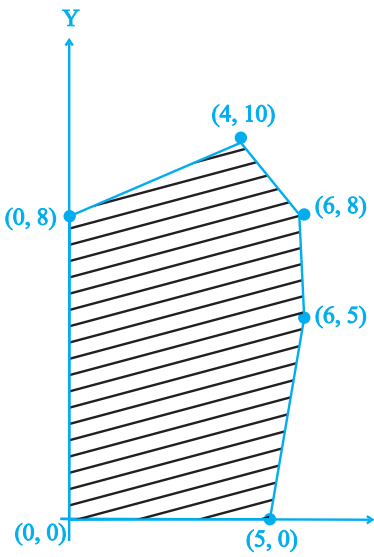
The feasible solution for a LPP shown in Fig. 12.12. Let z = 3x - 4y be objective functio. (Maximum value of Z + Minimum value of Z) is equal to:
If $\text{f(x)}=\log_{\text{x}^2}(\log\text{x}),$ the f(x) at x = e is:
  1. $0$
  2. $1$
  3. $\frac{1}{\text{e}}$
  4. $\frac{1}{2\text{e}}$
If a matrix has mm rows and nn columns then its order is:
  1. $\text{m}+\text{n}$
  2. $\text{n}\times\text{n}$
  3. $\text{m}\times\text{m}$
  4. $\text{m}\times\text{n}$
Let $A$ and $B$ be two invertible matrices of order $3 \times 3$. If $\operatorname{det}\left(A B A^{\prime}\right)=8$ and $\operatorname{det}\left(A B^{-1}\right)=8$, then $\operatorname{det}\left(B A^{-1} B^{\prime}\right)$ is equal to