MCQ
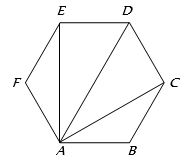
If $ ABCDEF$  is a regular hexagon and $\overrightarrow {AB} + \overrightarrow {AC} + \overrightarrow {AD} + \overrightarrow {AE} + \overrightarrow {AF} = \lambda \,\overrightarrow {AD} ,$ then $\lambda = $
  • A
    $2$
  • $3$
  • C
    $4$
  • D
    $6$

Answer

Correct option: B.
$3$
b
(b) By triangle law, $\overrightarrow {AB} = \overrightarrow {AD} - \overrightarrow {BD} ,$

$\overrightarrow {AC} = \overrightarrow {AD} - \overrightarrow {CD} $
Therefore, $\overrightarrow {AB} + \overrightarrow {AC} + \overrightarrow {AD} + \overrightarrow {AE} + \overrightarrow {AF} $

= $3\overrightarrow {AD} + (\overrightarrow {AE} - \overrightarrow {BD} ) + (\overrightarrow {AF} - \overrightarrow {CD} ) = 3\overrightarrow {AD} $

Hence $\lambda = 3$, [Since $\overrightarrow {AE} = \overrightarrow {BD,} \,\overrightarrow {AF} \, = \overrightarrow {CD} ]$.
Need a full question paper?

Generate a complete, print-ready paper with questions like this in minutes — across 16+ boards, with answer keys.

Start Generating Free

Similar questions

If $P \equiv (0,\,1,\,0),Q \equiv (0,\,0,\,1)$, then projection of $PQ$ on the plane $x + y + z = 3 $ is
The production of item $A$ is $x$ and the production of item $B$ is $y .$ If the corner points of the bounded feasible region are $(1,0),(2,0),(0,2)$ and $(0,1)$ then the maximum profit $z=2000 x+5000 y$ is $\ldots \ldots$
If $\hat{a}, \hat{b}, \hat{c}$ are unit vectors, then least value of $\left | \hat{a}+\hat{b} \right |^2+\left | \hat{b}+\hat{c} \right |^2+\left | \hat{c}+\hat{a} \right |^2$ will be-
The integral $\int {\frac{{xdx}}{{2 - {x^2} + \sqrt {2 - {x^2}} }}} $ equals
The differential equation of all conics with centreat origin is of order:
  1. 2
  2. 3
  3. 4
  4. 1
The value of $C$ for which $P\,(X = k) = C{k^2}$ can serve as the probability function of a random variable $X$ that takes $0, 1, 2, 3, 4$ is
The area bounded by the curve y = f(x), x-axis, and the ordinates x = 1 and $(\text{b}-1)\sin(3\text{b}+4)$ Then, f(x) is:
  1. $(\text{x}-1)\cos(3\text{x}+4)$
  2. $\sin(3\text{x}+4)$
  3. $\sin(3\text{x}+4)+3(\text{x}-1)\cos(3\text{x}+4)$
  4. none of these
By graphical method, the solution of linear programming problem
Maximize Z = 3x1 + 5x2
Subject to
3x1 + 2x2 ≤ 18
x1 ≤ 4
x2 ≤ 6
x1 ≥ 0, x2 ≥ 0, is:
  1. x1 = 2, x2 = 0, Z = 6
  2. x1 = 2, x2 = 6, Z = 36
  3. x1 = 4, x2 = 3, Z = 27
  4. x1 = 4, x2 = 6, Z = 42
Let a function $f:[0,5] \rightarrow \mathrm{R}$ be continuous. $f(1)=3$ and $\mathrm{F}$ be defined as

$\mathrm{F}(\mathrm{x})=\int\limits_{1}^{\mathrm{x}} \mathrm{t}^{2} \mathrm{g}(\mathrm{t}) \mathrm{dt},$ where $\mathrm{g}(\mathrm{t})=\int\limits_{1}^{\mathrm{t}} \mathrm{f}(\mathrm{u}) \mathrm{du}$

Then for the function $\mathrm{F}$, the point $\mathrm{x}=1$ is 

If the resultant of two forces of magnitudes $ P $ and $Q$  acting at a point at an angle of ${60^o}$ is $\sqrt 7 Q,$ then $P/Q$  is