MCQ
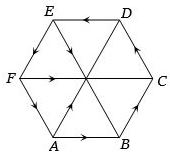
If $ABCDEF$ is regular hexagon, then $\overrightarrow {AD} \, + \overrightarrow {EB} + \overrightarrow {FC} = $
  • A
    $0$
  • B
    $2\overrightarrow {AB} $
  • C
    $3\overrightarrow {AB} $
  • $4\overrightarrow {AB} $

Answer

Correct option: D.
$4\overrightarrow {AB} $
d
(d)A regular hexagon  $ABCDEF.$

We know from the hexagon that $\overrightarrow {AD} $ is parallel to $\overrightarrow {BC} $ or $\overrightarrow {AD} = 2\,\overrightarrow {BC} $; $\overrightarrow {EB} $ is parallel to $\overrightarrow {FA} $

or $\overrightarrow {EB} = 2\overrightarrow {FA} $, and $\overrightarrow {FC} $ is parallel to $\overrightarrow {AB} $ or $\overrightarrow {FC} = 2\,\overrightarrow {AB} $.

Thus $\overrightarrow {AD} + \overrightarrow {EB} + \overrightarrow {FC} = 2\,\overrightarrow {BC} + 2\,\overrightarrow {FA} + 2\,\overrightarrow {AB} $

$ = 2(\overrightarrow {FA} + \overrightarrow {AB} + \overrightarrow {BC} ) = 2(\overrightarrow {FC} ) = 2(2\overrightarrow {AB} ) = 4\,\overrightarrow {AB} $.
Need a full question paper?

Generate a complete, print-ready paper with questions like this in minutes — across 16+ boards, with answer keys.

Start Generating Free

Similar questions

The sum of infinite terms of the following series $1 + \frac{4}{5} + \frac{7}{{{5^2}}} + \frac{{10}}{{{5^3}}} + .........$ will be
Integral of $\sqrt {1\,\, + \,\,2\,\cot \,x\,\,(\cot \,x\,\, + \,\,\cos ec\,x)} $ $w.r.t.\, x$ is :
Two sides of a parallelogram are along the lines, $x + y = 3$ and $x -y + 3 = 0$. If its diagonals intersect at $(2, 4)$, then one of its vertex is
The letters of the word $MODESTY$ are written in all possible orders and these words are written out as in a dictionary, then the rank of the word $MODESTY$ is
Let $f :\left[\frac{1}{2}, 1\right] \rightarrow R$ (the set of all real numbers) be a positive, non-constant and differentiable function such that $f^{\prime}(x)<2 f(x)$ and $f\left(\frac{1}{2}\right)=1$. Then the value of $\int_{1 / 2}^1 f(x) d x$ lies in the interval
If a complex number $z$ statisfies the equation $x + \sqrt 2 \,\,\left| {z + 1} \right|\,+ \,i\, = \,0,$ then $\left| z \right|$ is equal to
If a unit vector $\vec r$ makes angles $\frac{\pi }{3}$ with $\hat i$, $\frac{\pi }{4}$ with $\hat j$ and $\theta  \in \left( {0,\pi } \right)$ with  $\hat k$, then a value of $\theta$ is
Let $f (x) =$ $\left| {\begin{array}{*{20}{c}}{1\, + \,{{\sin }^2}x}&{{{\cos }^2}x}&{4\,\sin \,2x}\\{{{\sin }^2}x}&{1\, + \,{{\cos }^2}x}&{4\,\sin \,2x}\\{{{\sin }^2}x}&{{{\cos }^2}x}&{1\, + \,4\,\sin \,2x}\end{array}} \right|$, then the maximum value of $f (x) =$
If the length of the perpendicular from the point $(\beta , 0, \beta )\, (\beta  \neq 0)$ to the line $\frac{x}{1} = \frac{{y - 1}}{0} = \frac{{z + 1}}{{ - 1}}$ is $\sqrt {\frac{3}{2}} $, then $\beta $ is equal to
If the lines $x\,=\,ay\,+\,b,\,\,z\,=\,cy\,+\,d$ and $x\, = \,a\,'z + \,b\,',\,\,y = \,c\,'z\, + \,d\,'$ are perpendicular, then