Question
If $A=\left[\begin{array}{ccc}\cos \alpha & -\sin \alpha & 0 \\ \sin \alpha & \cos \alpha & 0 \\ 0 & 0 & 1\end{array}\right]$, then find $(\operatorname{adj} A)^{-1}$.

Answer

(a): We have, $|A|=\cos ^2 \alpha+\sin ^2 \alpha=1 \neq 0$
So, $A^{-1}$ exists.
We know adj $A=|A| A^{-1}$
$
\begin{array}{lll}
\Rightarrow & \text { adj } A=A^{-1} & {[\because|A|=1]} \\
\Rightarrow & (\operatorname{adj} A)^{-1}=\left(A^{-1}\right)^{-1}=A &
\end{array}
$

Need a full question paper?

Generate a complete, print-ready paper with questions like this in minutes — across 16+ boards, with answer keys.
Start Generating Free

Similar questions

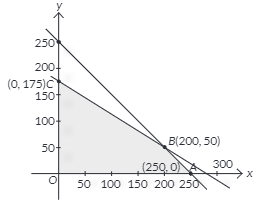
The corner points of the bounded feasible region of an LPP are $O(0,0), A(250,0), B(200,50)$ and $C(0,175)$. If the maximum value of the objective function $Z=2 a x+$ by occurs at the points $A(250,0)$ and $B(200,50)$, then the relation between $a$ and $b$ is:
Image
The equation of a line passing through point (2, -1, 0) and parallel to the line $\frac{ x }{1}=\frac{ y -1}{2}=\frac{2- z }{2}$ is:
If $A$ is any square matrix, then which of the following is skew$-$symmetric?
The signum function, $f: R \rightarrow R$ is given by $f(x)=\left\{\begin{array}{ll}1, & x>0 \\ 0, & x=0 \\ -1, & x<0\end{array}\right.$ is
The direction cosines of any normal to the xy plane are:
  1. 1, 0 ,0
  2. 0, 1, 0
  3. 1, 1, 0
  4. 1, 1, 0
The distance of the plane through the intersection of the planes ax + by + cz +d = 0 and lx + my + nz + P = 0 and parallel to the line y = 0, z = 0
If $ 3\cos ^{ -1 }{ \text{x} } +\sin ^{ -1 }{\text{ x} } =π$ then x:
  1. $\frac { 4 }{ \sqrt { 2 } }$
  2. $ -\frac { 1 }{ \sqrt { 2 } }$
  3. $\frac { 1 }{ \sqrt { 2 } }$
  4. $\frac { 1 }{ \sqrt { 4 } }$
What are the direction ratios of normal to the plane 2x - y + 2z + 1 = 0:
  1. (2, -1, 2)
  2. $\big(1,\frac{1}{2},1\big)$
  3. (1, -2, 1)
  4. None of the above
Mark the correct alternative in the following question for the binary operation * on Z defined by a * b = a + b + 1, the identity element is:
  1. 0
  2. -1
  3. 1
  4. 2
The direction ratios of the line perprndicular to the lines $\frac{\text{x}-7}{2}=\frac{\text{y}+17}{-3}=\frac{\text{z}-6}{1}$ and, $\frac{\text{x}+5}{1}=\frac{\text{y}+3}{2}=\frac{\text{z}-4}{-2}$ are proportional to:
  1. 4, 5, 7
  2. 4, -5, 7
  3. 4, -5, -7
  4. -4, 5, 7